
How to Read a Greyhound Race Card: Every Column and Symbol Explained
 Available in US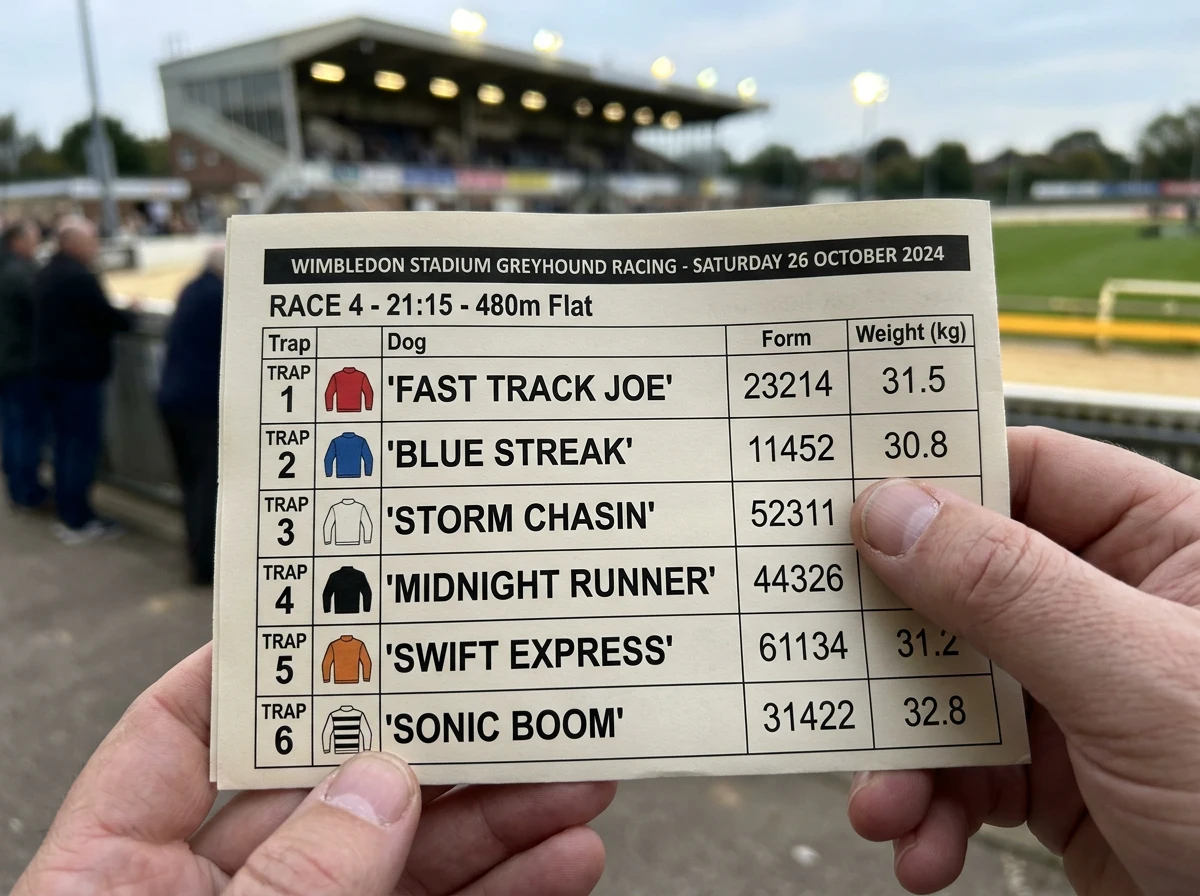
The Race Card Is Your Primary Data Source at Any Greyhound Meeting
Before there were betting apps, price comparison websites or data APIs, there was the race card. Printed on thin paper at the track or displayed on your screen, it contains everything you need to assess six greyhounds in roughly 90 seconds — if you know what you are looking at. Approximately 25,000 BAGS races are staged annually across the UK’s 18 GBGB-licensed stadiums, and every one of them comes with a card that follows the same fundamental structure.
I spent my first three months of greyhound betting looking mainly at two things on the race card: the dog’s name and the odds. That approach had a predictable success rate — roughly equivalent to throwing a dart. Learning to decode every column transformed my betting from guesswork into analysis. The race card is not a list of runners; it is a compressed dataset, and the bettors who can read it fastest and most accurately hold a persistent edge.
See also: how to win greyhound betting — your greyhound betting reference.
Breaking Down Every Column: Trap, Form, Time, Weight, Grade
Each runner on a greyhound race card occupies a row, and the columns provide the data that form analysis is built on. The specific layout varies slightly between platforms, but the core information is consistent.
The trap number (1-6) identifies the starting position, usually colour-coded: red for trap 1, blue for 2, white for 3, black for 4, orange for 5, black-and-white stripes for 6. This is not decorative — the trap number directly affects the dog’s chance of leading at the first bend. Trap 1 carries a win rate of approximately 18-19% against the theoretical 16.6%, a geometric advantage that compounds with the dog’s early pace.
The dog’s name appears next, often with its sire and dam listed beneath. The name itself is irrelevant to analysis, but the breeding can occasionally indicate speed or stamina characteristics if you are familiar with the bloodlines. More practically, the trainer’s name is listed alongside — and trainer form at specific tracks is a factor that most casual bettors overlook entirely.
Weight is recorded in kilograms and typically shows the dog’s weight at the current meeting alongside its weight at previous runs. A stable weight suggests consistent condition; a gain or loss of a kilogram or more between runs can indicate changes in fitness, health or training that may affect performance. Heavier dogs (33kg+) tend to handle wet surfaces better; lighter sprinters (under 29kg) often perform best on firm, dry tracks.
The finishing time from recent races is usually displayed in seconds to two decimal places. A time of 29.45 over 480 metres is faster than 29.72. But raw times are only directly comparable at the same track — track configurations, surfaces and conditions vary, so a 29.50 at Romford represents different ability than a 29.50 at Nottingham. Always compare times within a venue, not across venues.
Grade appears as a letter-number combination (A1, A2, A3 and so on). This tells you the competitive standard of the race. A dog that has been racing in A2 and is now entered in A3 has dropped a grade, which could indicate declining form or could represent an opportunity where a competitive dog meets weaker opposition. Favourites in graded races win about 33% of the time, but class droppers in the right circumstances can significantly outperform that baseline.
Deciphering Form Figures and Positional Abbreviations
The form line is the most information-dense element on the card, and the one that rewards closest reading. It shows the dog’s finishing positions in its most recent races, with the latest run on the right. A form line of “2-1-3-5-1” tells a story: the dog won its most recent start, had a poor run before that (fifth), then alternated between competitive finishes. Reading left to right gives you the chronological arc of the dog’s recent career.
Numbers represent finishing positions: 1 through 6. Letters encode specific events during the race. “F” indicates a fall. “T” means the dog was trapped or impeded at the start. “B” indicates being bumped during the race. “W” may appear for a dog that ran wide. These letters matter because they provide context that the finishing position alone does not capture. A dog finishing fifth because it fell at the second bend is a fundamentally different proposition from one finishing fifth because it was simply outpaced.
Some cards include additional positional data beyond the finishing position. You might see the dog’s position at the first bend (e.g., “led 1st bend” or “mid 1st bend”) in the race comments. This sectional information is gold for assessing early pace — a dog that consistently leads at the first bend from an inside trap has a different race profile than one that consistently finishes fast from behind.
Distance beaten is another form element worth noting. A dog finishing second, beaten half a length, ran a far closer race than one finishing second by five lengths. Some cards express this numerically; others use descriptive terms. A “close second” is a more encouraging form line than a distant one, even though both show a “2” in the position column.
A 60-Second Race Card Assessment Method
When I am scanning a card for quick selections — say, during a busy BAGS afternoon with races every twelve minutes — I use a stripped-down assessment that takes about a minute per race. It does not replace full form study, but it filters out poor bets efficiently.
First, I scan the trap draws against running styles. If the race comments for previous runs tell me a dog is a confirmed railer drawn in trap 5, that is an immediate downgrade. Conversely, a wide runner drawn in trap 6 has clear running room on the outside — an upgrade.
Read our guide to greyhound form analysis.
Second, I check the most recent finishing time for each dog, adjusting mentally for grade. A dog showing 29.40 in A2 company is running faster than one showing 29.60 in A4. If the faster dog has dropped to the same grade as the slower one, the time comparison favours the dropper.
Third, I look at recent form consistency. A form line showing “1-2-1-2-3” is more trustworthy than “1-6-1-5-2.” The consistent dog finishes in roughly the same position regardless of circumstances; the inconsistent one is dependent on a clean run or a specific set of conditions that may not materialise.
Fourth, I note any significant weight change. More than half a kilogram up or down from the previous run prompts a closer look at why — is the dog carrying extra condition after a break, or has it been trimmed down for a sprint?
This 60-second method does not identify every winner. It identifies the runners that are worth considering and, equally importantly, the ones that are not. Eliminating two or three dogs from a six-runner field narrows your focus to the genuine contenders and prevents you from backing runners whose form analysis does not support the price. The race card gives you the data; the discipline of reading it systematically gives you the edge.
