
Greyhound Betting Odds Explained: SP, Implied Probability and the Overround
 Available in US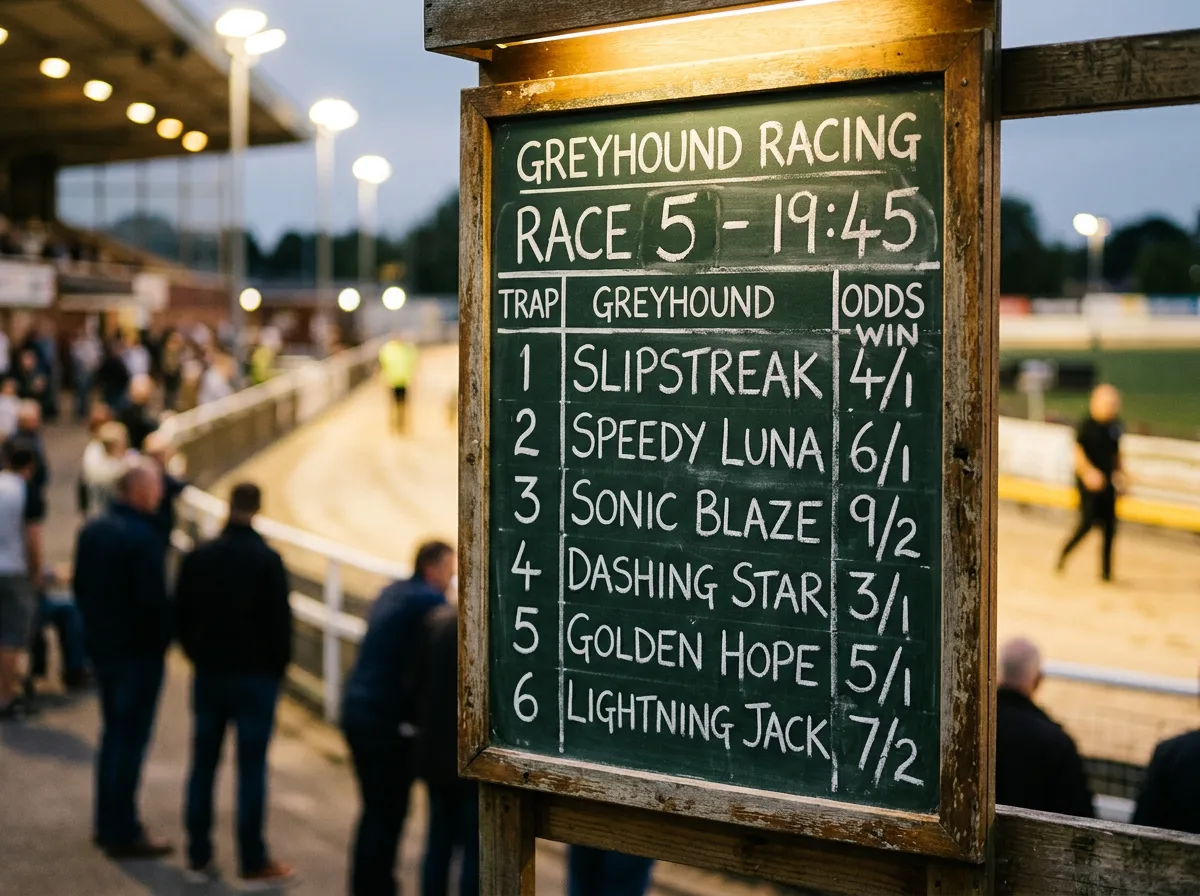
What Greyhound Betting Odds Really Represent
Odds are the language of betting, and most greyhound punters are functionally illiterate. I do not mean that as an insult — I was the same for years. I could read a price board, I knew that 2/1 paid more than evens, and I had a vague sense that longer odds meant lower chances. But I could not convert those numbers into probabilities. I could not calculate the bookmaker’s margin. And I certainly could not identify when a price represented genuine value versus a trap dressed up in attractive numbers. Learning the mechanics of odds was the single most productive week of study I have invested in greyhound betting.
Every set of odds on a greyhound race is a compressed statement about probability, risk, and profit margin. The bookmaker is telling you — in coded form — what they believe each dog’s chance of winning is, and how much of a cut they are taking for the privilege of offering you the bet. A typical greyhound race carries an overround of approximately 125%, meaning the bookmaker has built a roughly 25% margin into the prices. Understanding how that margin works, and where it is distributed across the field, is the first step toward identifying the bets where the margin is thinnest and the value is greatest.
See also: how to win greyhound betting — your complete guide to greyhound betting.
Fractional, Decimal and American Odds — One Concept, Three Formats
Walk up to a bookmaker’s board at any UK greyhound track and you will see fractional odds: 5/2, 7/4, 11/8. Open an online account and you might see the same prices expressed as decimals: 3.50, 2.75, 2.38. Check an American sportsbook and the format changes again: +250, +175, -114. Three formats, one underlying concept. They all answer the same question: for every pound I risk, how much do I get back if I win?
Fractional odds are the traditional format in UK greyhound racing. The number on the left is the profit; the number on the right is the stake. At 5/2, you profit 5 pounds for every 2 pounds staked. At 1/1 (evens), profit equals stake. At 1/2 (odds-on), you profit 1 pound for every 2 staked — less profit than risk, reflecting a dog the market considers likely to win. The mental arithmetic is straightforward for clean fractions but gets clunky with prices like 11/8 or 100/30. This is where decimal odds earn their keep.
Decimal odds express the total return per unit staked, including the stake itself. An odds-on price of 1/2 in fractional format becomes 1.50 in decimal — you get 1.50 pounds back for every pound bet, which is your original stake plus 50p profit. The 5/2 from above becomes 3.50 — your stake returned plus 2.50 profit. Decimals are easier to compare at a glance, especially across a full field of six runners, and they convert to implied probability with a single division (more on that shortly). Most serious bettors I know work in decimals internally, even if the boards they read show fractions.
American odds are built on a 100-unit baseline. A positive number (+250) tells you the profit on a 100-unit stake; a negative number (-200) tells you how much you need to stake to profit 100 units. This format is rare in UK greyhound betting, but if you use an international platform or compare markets across countries, you will encounter it. The conversion is mechanical: +250 American equals 3.50 decimal equals 5/2 fractional. Same price, different label.
Which format should you use? Whichever one makes probability calculation easiest for you. I use decimals because dividing 1 by the decimal odds gives me the implied probability instantly — 1 divided by 3.50 equals 0.286, or roughly a 28.6% chance. That conversion is the bridge between the price on the board and the probability in your head, and it is the skill that separates bettors who understand what they are buying from those who are just picking numbers.
Converting Odds to Implied Probability
Here is a question I ask anyone who tells me they backed a 3/1 shot: what chance did you give it of winning? If the answer is a blank stare, they did not actually assess the bet — they just liked the dog and thought the payout looked decent. Converting odds to implied probability is the single most useful calculation in betting, and it takes three seconds.
For decimal odds, divide 1 by the price. A decimal price of 4.00 gives an implied probability of 1/4.00 = 0.25, or 25%. For fractional odds, divide the right-hand number by the sum of both numbers. At 3/1, the calculation is 1/(3+1) = 0.25, or 25%. At 5/2, it is 2/(5+2) = 0.286, or 28.6%. The result tells you what the bookmaker’s price implies about the dog’s chance of winning.
Now here is the crucial part: implied probability is not the same as actual probability. It includes the bookmaker’s margin. If you add up the implied probabilities of all six dogs in a race, the total will exceed 100% — typically landing around 125% for a greyhound race. That excess is the overround, and it represents the bookmaker’s built-in profit. Each dog’s implied probability is slightly inflated above its true probability, which means the odds on every runner are slightly shorter than they should be if the market were perfectly fair.
Favourites in graded greyhound races win approximately 30-35% of the time. If the market prices a favourite at 2/1 (implied 33.3%), the implied probability roughly matches the historical win rate, which suggests the favourite is fairly priced on average. But remember, that 33.3% includes the overround — the true probability might be closer to 28-30% once you strip the margin out. This is why blind favourite-backing loses money: the prices account for the popularity of the bet, not just the probability of the outcome.
I calculate implied probability for every runner before comparing it to my own form-based assessment. If the price implies 20% and I assess the dog at 30%, there is a ten-point gap between the market’s view and mine. If I am right, that gap is where the profit lives. If I am wrong, I need to examine my method. Either way, the calculation forces me to confront the market’s opinion rather than ignoring it, which is a discipline that improves every aspect of my betting.
Calculating the Bookmaker’s Overround Step by Step
The overround is the bookmaker’s insurance policy, and calculating it reveals exactly how much of a disadvantage you face before the traps even open. Let me walk through a real example using a hypothetical six-dog race to show how the numbers work.
Suppose the six runners are priced as follows in decimal odds: 3.00, 4.00, 5.00, 6.00, 8.00, and 10.00. Convert each to implied probability: 33.3%, 25.0%, 20.0%, 16.7%, 12.5%, and 10.0%. Add them up: 33.3 + 25.0 + 20.0 + 16.7 + 12.5 + 10.0 = 117.5%. In a fair market, the total would be exactly 100%. The excess — 17.5 percentage points — is the overround.
A 117.5% overround is actually quite generous by greyhound standards. The typical greyhound race sits closer to 125%, and I have seen markets on less liquid races push above 130%. Compare that to horse racing, where competitive markets often come in below 115%, and you see the structural challenge greyhound bettors face. The higher overround means the bookmaker is taking a bigger slice of every pound wagered, which means you need a larger edge to overcome the built-in margin.
Where the overround is distributed across the field matters as much as the total. Bookmakers do not inflate every dog’s probability equally. They tend to load the margin most heavily onto the favourite and lightest onto the outsiders. This is because favourites attract the most money and the bookmaker’s risk is concentrated there. The practical effect: favourites are often the worst value in the race because their odds are shortened the most, while outsiders may be priced closer to their true probability because the bookmaker has less exposure on them.
You can check the overround of any race in under a minute. Convert all six prices to implied probability, sum them, and subtract 100. The result is the percentage margin the bookmaker has built in. I do this habitually, not because it changes my selections, but because it calibrates my expectations. A race with a 130% overround is harder to beat than one at 118%. In the higher-margin race, I need to be more selective — only betting when my edge is large enough to overcome the wider margin. In a lower-margin race, even a modest edge can produce positive expected value.
Starting Price and Best Odds Guaranteed: When to Lock In
Starting Price — SP — is the official odds of a greyhound at the moment the traps open. It is determined by the on-course bookmakers at the track, and it serves as the settlement price for anyone who did not take a fixed price earlier. If you place a bet “at SP,” you are accepting whatever price is available at the off, which might be better or worse than the odds you saw when you made your selection.
The timing question is central. Greyhound markets move in the final minutes before a race, sometimes significantly. A dog might open at 5/1 in the morning market and be 3/1 by the off, because money has come for it during the day. If you took 5/1 in the morning, you locked in the better price. If you took SP, you got 3/1. Conversely, a dog that drifts from 3/1 to 5/1 rewards SP bettors over those who locked in early at the shorter price.
Best Odds Guaranteed — BOG — is a feature offered by many bookmakers that eliminates this dilemma on certain markets. Under BOG terms, if you take a fixed price and the SP turns out to be higher, the bookmaker pays you at the higher price. If the SP is lower, you keep the fixed price you took. It is essentially a free option on price improvement, and it is valuable. Off-course greyhound betting in Great Britain accounted for nearly 740 million pounds in a single financial year, and a significant portion of that was settled at SP or BOG terms.
My approach: I take a fixed price when I believe the dog’s odds will shorten before the off — when my analysis suggests the dog is underpriced and the market will catch up. I take SP when I am unsure about the direction of movement, particularly for dogs I expect to drift. If BOG is available, I take the fixed price every time, because the downside is eliminated. Grainne Hurst of the Betting and Gaming Council has highlighted the differences between licensed operators — who offer features like BOG and contribute to industry levies — and unlicensed platforms that do not. Those contributions, incidentally, fund aspects of the sport’s infrastructure, which is worth understanding even if it does not change your bet-by-bet decisions.
One tactical note: SP in greyhound racing tends to be less reliable as a “true” market indicator than in horse racing, because on-course greyhound markets are thinner and a single large bet at the track can distort the starting price. This is another reason to take fixed prices where possible — they reflect the broader market’s assessment rather than the idiosyncratic activity of a handful of on-course punters.
How Betting Exchange Odds Differ From Bookmaker Prices
The first time I compared the exchange price to the best bookmaker price on the same greyhound, the difference was startling. The bookmaker was offering 7/2. The exchange had the same dog available at 9/2. On a 10-pound stake, that is the difference between a 35-pound profit and a 45-pound profit — 10 pounds more for taking an extra thirty seconds to check a second screen. I have been checking both ever since.
Exchanges operate without a traditional overround because there is no bookmaker setting the odds. Instead, backers and layers negotiate prices directly, and the exchange takes a commission on winning bets — usually between 2% and 5%. The result is that exchange odds are typically better than bookmaker odds, because the prices are closer to the market’s genuine assessment of probability without the inflated margin.
UK greyhound betting turnover sits at around 1.5 billion pounds, but the exchange share of that market is small. Greyhound exchange markets lack the deep liquidity you find in football or horse racing, which means you cannot always get matched at the price you want, and large stakes are difficult to place without moving the market against yourself. At a weekday BAGS meeting, exchange liquidity on individual races can be thin — sometimes just a few tens of pounds available at the best price.
For the value bettor, exchanges serve two purposes. First, they offer better odds when liquidity is available. Even a single point of extra odds on a 3/1 shot — getting 7/2 instead of 3/1 — improves your long-term return meaningfully over hundreds of bets. Second, they allow lay betting — betting against a dog to lose — which opens up an entirely different set of strategies covered elsewhere in this series. The combination of back and lay markets gives exchange users flexibility that traditional bookmaker accounts cannot match.
My workflow is simple. I check the exchange first. If the price I want is available and the liquidity is sufficient for my stake, I place the bet there. If not, I take the best bookmaker price. The extra minute per race adds up to a measurably better return, and it costs nothing beyond the time investment.
Reading Odds Movement Before a Greyhound Race
Fifteen minutes before the off, the prices on a race card are a forecast. Five minutes before, they are a negotiation. At the moment the traps open, they are a verdict. Watching that transition from forecast to verdict is one of the most informative habits a greyhound bettor can develop.
Odds move for two reasons: money and information. When a large bet lands on a particular dog, bookmakers shorten that dog’s price to manage their liability and lengthen the prices on the rest of the field to compensate. When new information reaches the market — a dog looked sharp in the parade, or word circulates that a runner has been struggling in recent trials — bets follow, and prices adjust. In greyhound markets, which are smaller and less liquid than horse racing, individual bets can move prices more noticeably, which makes the signals both easier to spot and more prone to noise.
Learn about value betting in greyhound racing.
A “steamer” — a dog whose price shortens sharply in the final minutes — usually indicates informed money. Someone with access to the dog’s connections, or who has observed the dog’s condition trackside, is backing it with enough conviction to move the market. Steamers win at a higher rate than their opening odds implied, which is logical — the people closest to the dog have better information than the market at large. That said, steamers are not automatic bets, because the shortened price may already reflect the edge. If a dog steams from 6/1 to 3/1, the information is priced in by the time you act.
A “drifter” — a dog whose price lengthens — sends the opposite signal. Money is moving away from it, either toward other runners or simply not arriving as expected. Drifters win at a lower rate than their opening odds implied. When I see a dog I was considering start to drift, I reassess. Has something changed? Is the drift a reaction to a visible issue in the parade? Is it simply a correction from an overly aggressive opening price? The drift alone does not answer these questions, but it tells me to ask them.
I monitor price movements through a comparison tool that refreshes in real time. The five-minute window before the off is where the most meaningful movements occur, and I pay closest attention to changes of a full point or more on the fractional odds scale — 4/1 to 3/1, or 5/2 to 7/2. Smaller fluctuations are often just market noise. Larger moves are signals, and integrating them into your value assessment is a skill that sharpens with practice and repetition.
