
Greyhound Trap Bias Statistics: Which Starting Positions Win Most
 Available in US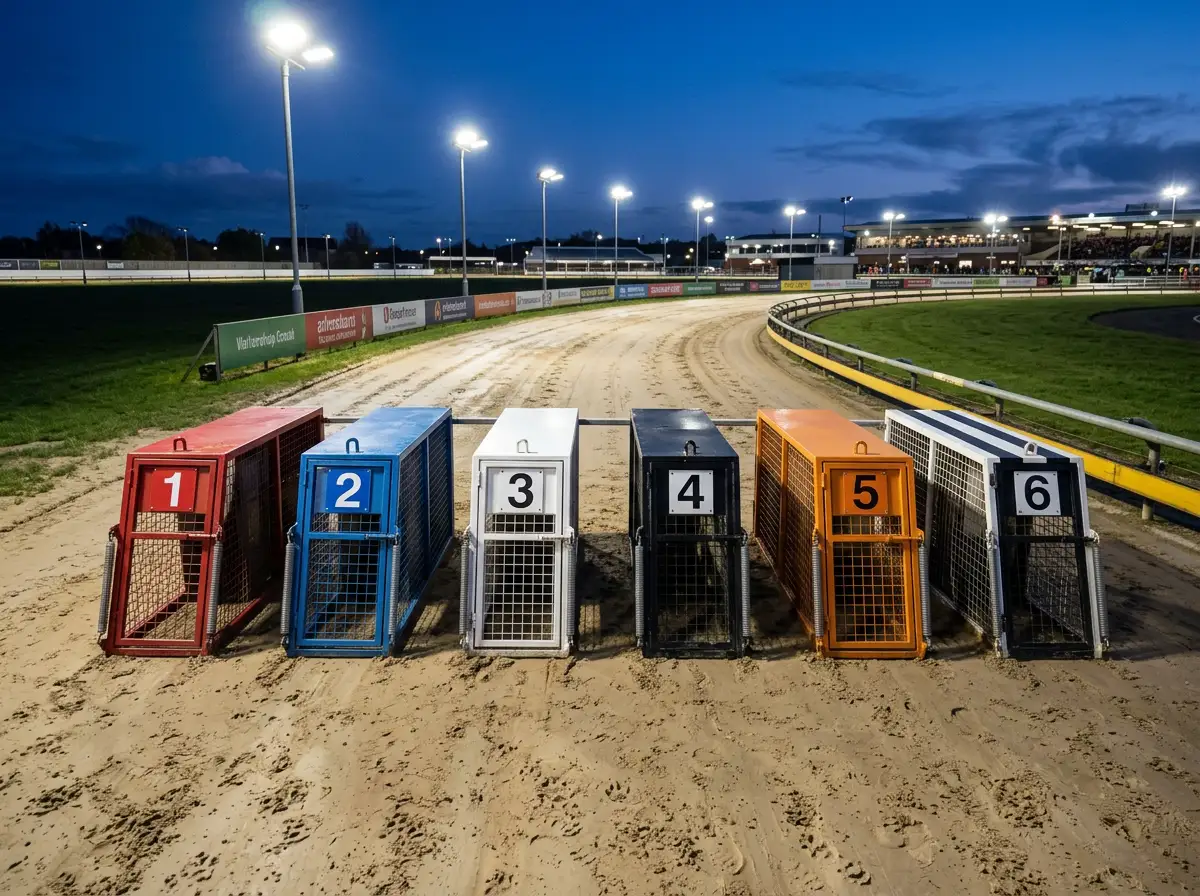
Trap 1 Wins More Than It Should — Here Is the Data
I spent my first six months betting on greyhounds without once checking trap statistics. I picked dogs on form, on trainer, on gut feeling — everything except the one factor that is literally built into the track geometry. Then a friend who had been grinding data for years showed me his spreadsheet: trap 1 at his local track was winning 22% of 480-metre races, while trap 6 managed barely 11%. Same fields, same dogs rotating through the draw — but the starting position alone was shifting the odds by a factor of two. That was the day I stopped ignoring the traps.
Across GBGB-licensed tracks, trap 1 carries a win rate of approximately 18-19%, comfortably above the theoretical 16.6% you would expect if all six positions were equally likely to produce a winner. That two-to-three percentage point edge sounds small until you compound it across thousands of races and realise it reshapes the entire market. The bias is not uniform — it varies by track, by distance, by weather, and by the running styles of the dogs in the field. But it exists everywhere, and understanding it is non-negotiable for anyone serious about greyhound betting.
What follows is a breakdown of the data behind trap bias: where it comes from, how it varies, and — most importantly — how to weave it into your selection process without falling into the trap of treating it as a stand-alone system.
See also: how to win greyhound betting — dedicated to greyhound racing betting.
Why Inside Traps Have a Geometric Advantage
Think of a greyhound track as an oval — two straights connected by two semicircular bends. Now imagine six dogs breaking from their traps at roughly the same speed. The dog in trap 1, closest to the inside rail, has the shortest path around the first bend. The dog in trap 6, furthest from the rail, has the longest. That difference in distance is small in absolute terms — perhaps three to five metres over the first bend — but in a sport where races are decided by fractions of a second, three metres is an eternity.
The advantage compounds at the first bend itself. Greyhounds naturally converge toward the rail as they enter the turn, because running tight to the inside means covering less ground. The trap 1 dog is already on the rail; it does not need to move laterally at all. Every other dog has to angle inward, and in doing so, they risk colliding with each other, losing momentum, or being forced wide by a rival that got there first. The result is a predictable pattern: inside traps reach the first bend with cleaner runs, while outside traps are more likely to encounter interference.
This is not speculation. It is geometry. The circumference of a circle increases linearly with radius, so each lane further from the centre adds a fixed amount of extra distance on every bend. On a track with tight bends — a smaller radius — the penalty for running wide is greater. On a track with sweeping, wide bends, the difference between inside and outside is smaller, and trap bias tends to be less pronounced. Track design, in other words, is the primary driver of how strong the inside advantage is at any given venue.
There is a secondary effect worth noting. Dogs that reach the first bend in front tend to stay in front, not just because they have the positional advantage, but because the dogs behind them have fewer overtaking opportunities on bends. Overtaking on a greyhound track happens almost exclusively on the straights, and only if the pursuing dog has significantly more pace. The first bend, then, acts as a sorting mechanism: get there first, and the race is yours to lose. That is why early pace — the sectional time to the first turn — and trap draw are so tightly linked in predicting outcomes.
Trap Win Rates Across UK Tracks: Venue-Level Breakdown
If someone tells you “trap 1 always wins,” they have never compared Kinsley to The Valley. The favourite win rate across 18 GBGB stadia in 2021 ranged from 31.6% at Kinsley to 42% at The Valley — a ten-point spread that tells you venue-level context matters enormously. Trap bias follows the same pattern: it exists everywhere, but its magnitude and shape differ from track to track in ways that can make or break your selections.
At tight, compact tracks with sharp bends, the inside advantage is amplified. Dogs drawn in traps 1 and 2 consistently outperform their theoretical win expectation, sometimes by five or six percentage points. At these venues, the geometry penalty I described earlier is at its strongest: the extra distance for outside runners is greater, and the crowding at the first bend is more intense because the dogs converge over a shorter arc. I have seen individual tracks where trap 1 wins 23-24% of races at certain distances — almost one in four — while trap 6 struggles to hit 10%.
Larger tracks with sweeping bends tell a different story. The distance penalty for running wide is smaller, so outside traps are less disadvantaged. Trap bias still exists — the inside rail is still the shortest path — but it is flatter. You might see trap 1 at 17-18% and trap 6 at 14-15%, a much narrower gap. At these venues, form and pace matter more than draw, and a strong dog in trap 5 is not nearly as compromised as it would be at a tighter circuit.
The UK currently has 18 GBGB-licensed stadia, down from over 70 in the post-war era. Each has its own configuration, surface, and set of distances, which means each produces its own trap bias profile. I maintain a simple table for the two tracks I follow most closely, recording win percentages by trap and distance over rolling six-month periods. Six months gives enough data to be statistically meaningful — at tracks running multiple meetings per week, that is several hundred races per distance — without being so long that the data becomes stale.
You do not need to build this from scratch for every venue in the country. Pick one or two tracks, concentrate your betting there, and learn their bias profiles intimately. A bettor who knows that trap 2 at their local track overperforms at 480 metres but underperforms at 640 metres has an edge over anyone relying on national averages. National averages tell you that inside traps win more often. Venue-level data tells you by how much, at which distances, and under which conditions — and that is the data that translates into selections.
One caveat: trap bias data needs volume to be reliable. A single month of races at one track might produce misleading patterns simply because the sample is too small. I do not draw firm conclusions from fewer than 200 races at a specific track-distance combination. Below that threshold, random variation can create the appearance of patterns that are not real.
How Race Distance Changes Trap Bias Patterns
A sprint race and a middle-distance race at the same track are almost different sports from a trap bias perspective. I learned this the hard way at Monmore, where I had been backing inside traps profitably at 480 metres for months. When I applied the same logic to 680-metre races, I started losing. The data showed me why: at the longer distance, dogs have more time and space to recover from a poor break. The extra straight running allows faster dogs to overtake regardless of their starting position. The first-bend advantage, which dominates sprint races, is diluted by the second, third, and fourth bends where the field reshuffles.
Sprint races — typically 250 to 300 metres — show the strongest trap bias. These races often involve only one or two bends, and the run from traps to the first turn represents a larger proportion of the total race. A dog drawn in trap 1 that breaks quickly can establish a clear lead before any challenger reaches the bend, and with so little race left to run, there is almost no time for the field to recover. At sprint distances, the inside two traps often account for 40% or more of all winners.
Standard distances — 450 to 500 metres, the bread and butter of UK greyhound racing — produce moderate trap bias. The first bend matters, but two full circuits give dogs with late pace a chance to improve their position on the straights. Trap 1 still overperforms, but the advantage is smaller than at sprint distances, and the middle traps (3 and 4) tend to produce their fair share of winners because those dogs can tuck in behind the leaders without running wide.
Marathon distances — 640 metres and above — flatten the bias further. Over three or more circuits, stamina and racing intelligence outweigh starting position. I have seen trap 6 runners win marathon races they would have had no chance in at sprint distances, purely because they had the endurance to wear down front-runners who burned out on the third lap. If you are betting on marathon races, shift your emphasis away from trap draw and toward overall times, finishing patterns, and whether the dog has demonstrated staying ability over similar distances.
The practical rule I follow: weight trap draw most heavily in sprints, moderately at standard distances, and lightly in marathons. Adjust that weighting based on the specific track’s bend geometry — tight bends amplify the sprint effect, sweeping bends reduce it at every distance.
Wet vs Dry Conditions and Trap Performance Shifts
Rain changes everything on a greyhound track, and most bettors do not adjust for it. I have sat in the stands at Perry Barr on a wet Wednesday night, watching trap 1 win four of the first five races after a day of steady drizzle. The surface was heavy, the outside running line was chewed up, and every dog drawn wide was slipping and losing ground on the bends. The inside rail, slightly more sheltered and compacted, offered firmer footing. That is not anecdotal — it is a repeatable pattern I have observed at every sand-based track I follow.
Wet conditions slow the overall track surface, which tends to reduce the speed differential between dogs. Races bunch up, gaps narrow, and the advantage of a clean inside run becomes proportionally more important because there is less raw pace available for outside runners to use in making up ground. The net effect is a shift toward inside traps on most tracks when it rains.
Heat produces a different dynamic. Dry, warm conditions often create a faster surface, which favours dogs with genuine pace rather than positional advantage. When the track is quick, a strong dog drawn in trap 5 can break fast enough to overcome the geometric disadvantage and reach the first bend on even terms with inside runners. Hot weather also tends to firm up the outside running line, making it less of a penalty to run wide. The overall effect is a flattening of trap bias — inside traps still have an edge, but it is smaller than on a wet evening.
Wind is the factor most bettors overlook entirely. A strong headwind on the back straight slows dogs on that section of the track, which means dogs leading into the back straight lose less of their advantage — pursuing dogs cannot close the gap as easily against the wind. A tailwind on the home straight, conversely, helps closers make up ground in the final run to the line. I do not pretend to model wind effects precisely, but I note the conditions and factor them into my confidence level on each selection. A borderline bet on an inside trap in calm conditions might become a stronger selection if rain is falling, or a pass if a strong crosswind is swirling across the track.
Incorporating Trap Bias Into Your Selection Process
Trap bias is not a betting system. I have to say that clearly, because the single biggest mistake I see in greyhound betting forums is people treating trap statistics as a stand-alone method — blindly backing trap 1 in every race and expecting to profit. Trap 1 wins 18-19% of the time. That means it loses more than 80% of the time. If the market prices trap 1 runners at odds that reflect their actual probability of winning, there is no edge in backing them just because they are on the rail.
The value of trap bias data lies in integration, not isolation. It is one input in a multi-factor assessment that includes recent form and race card analysis, sectional times, grade, trainer, and running style. Favourites win roughly 30-35% of graded races, which means even the market’s top-ranked dog fails two out of three times — and those failures often trace back to an unfavourable draw that the market underweighted. Here is how I fold trap statistics into my process.
First, I use venue-specific trap data to set a baseline adjustment for each dog in the field. If trap 1 at this track and distance wins 21% of the time, I give the trap 1 runner a slight upgrade over the theoretical 16.6%. If trap 6 at this track wins only 11%, I apply a corresponding downgrade. These are not precise calculations — they are directional adjustments that shift my probability estimate by a few percentage points.
Second, I cross-reference trap draw with running style. A railer drawn in trap 1 gets a bigger upgrade than a wide runner drawn in trap 1, because the railer will actually use the inside position. A wide runner in trap 1 may break and immediately swing out, negating the geometric advantage entirely. Similarly, a wide runner drawn in trap 6 is in its natural position — the outside draw is less of a handicap than it would be for a railer who needs to cut across the field.
Third, I look at the early pace of the dog relative to the field. A fast-breaking dog in an inside trap is a potent combination — it reaches the rail first and establishes a lead at the first bend. A slow beginner in an inside trap squanders the positional advantage, because faster dogs from outside traps will reach the bend first and push the slow beginner wide. Trap draw without pace data is incomplete; pace data without trap draw is equally so.
Fourth, I consider tonight’s conditions. If it has been raining, I weight trap bias more heavily. If the surface is dry and fast, I weight it less. If the race is a marathon distance, trap draw becomes a minor factor. These conditional adjustments take seconds once you have internalised them, and they prevent the one-size-fits-all thinking that costs most bettors money.
Where to Find Reliable Trap Statistics
Good data is the foundation of this entire approach, so where do you actually find it? The honest answer is that greyhound data infrastructure lags well behind horse racing, but it has improved markedly in recent years. Sarah Newman of Arena Racing Company noted that growing footfall at greyhound stadiums in 2025 reflects increased interest in the sport, and that interest has pushed several platforms to expand their data offerings.
Read our greyhound form analysis guide.
GBGB’s official results service provides race cards and results for all licensed meetings, including finishing positions, times, and race comments. It is free and covers every BAGS and open fixture. For raw results data, this is the starting point. The downside is that it does not aggregate statistics into trap bias tables — you have to do that compilation yourself, either manually or with a simple script.
Third-party results sites offer pre-compiled trap statistics for individual tracks. Some present win percentages by trap and distance, updated regularly. The quality varies — check how frequently the data is refreshed and how large the sample size is. Any table based on fewer than a few hundred races per track-distance combination should be treated as indicative rather than definitive.
Betting exchanges publish starting price data and market information that can be useful for understanding how the market prices trap draw. Historical Betfair SP data, available from 2012 onward, allows you to compare the actual win rate of dogs at specific odds to the implied probability of those odds — which is a route into identifying whether the market systematically underprices or overprices certain trap positions.
My own approach is straightforward: I maintain a spreadsheet for the two tracks I bet on most frequently, recording the trap, distance, finishing position, and conditions for every race. After six months, I have enough data to see genuine patterns rather than noise. It takes five minutes per meeting to update, and it has paid for itself many times over. You do not need expensive software or proprietary databases. You need consistency, a simple recording method, and the patience to let the sample build before drawing conclusions.
