
Greyhound Tote Betting Explained: How Pool Odds Work and When to Use Them
 Available in US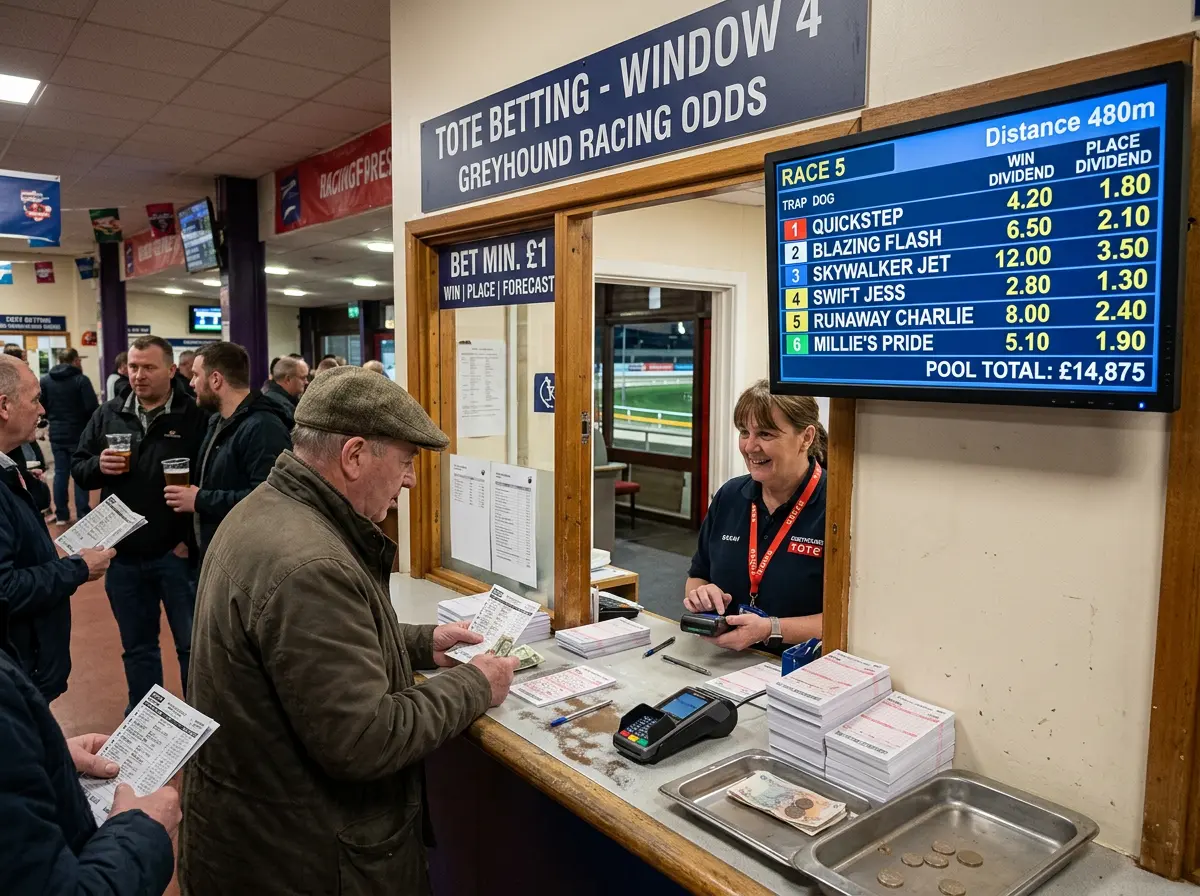
Tote Betting Offers Greyhound Punters a Different Odds Structure
Most greyhound bettors interact exclusively with fixed-odds bookmakers, where the price you take is the price you get. The tote operates on an entirely different principle, and understanding that difference can occasionally put you on the right side of odds that fixed-odds markets cannot match. UK greyhound betting generated turnover of approximately 1.5 billion pounds in 2022-23, with tote pools representing a small but distinct segment of that total.
I first encountered tote betting at an evening meeting when the dog I liked was 3/1 with the bookmakers and returned 7.20 on the tote — more than double the fixed-odds price. That does not happen often, but when it does, the mathematical advantage is overwhelming. The tote is not consistently better or worse than fixed odds; it is structurally different, and that structural difference creates occasional opportunities that a systematic bettor should not ignore.
See also: how to win greyhound betting — your source for greyhound betting.
How Parimutuel Pools Calculate Your Payout
The tote uses a parimutuel system: all bets on a race are pooled together, a deduction is taken for overheads and profit (typically 15-20% of the pool), and the remainder is divided among the winning tickets in proportion to their stake. You do not know your exact return when you place the bet; the final payout depends on the total pool size and how much of that pool was bet on the winning dog.
This creates a fundamentally different pricing dynamic from fixed odds. With a bookmaker, the odds reflect the bookmaker’s assessment of each dog’s chance, plus the overround margin (roughly 125% on a six-dog race). With the tote, the odds reflect the collective betting behaviour of everyone who placed a tote bet on that race. If a popular dog attracts 40% of the pool, its tote return will be modest regardless of its actual chance. If an unfancied dog attracts only 5% of the pool, its return will be large — even if the fixed-odds market prices it at similar levels to more popular runners.
The tote deduction functions as the equivalent of the bookmaker’s overround. At 15-20%, it is typically lower than the 25% fixed-odds overround on greyhound racing, which means the tote theoretically returns more money to bettors in aggregate. However, the variance in tote returns is higher because the payout is influenced by pool composition rather than a stable bookmaker price.
Tote Win, Place, Exacta, Trifecta and Jackpot Bets at the Dogs
Over 2 million people visit UK greyhound tracks annually, and the tote window is a fixture of the on-course experience. The bet types available through the tote map broadly onto fixed-odds equivalents, with some additions unique to pool betting.
A tote win bet is the simplest: back a dog to win, and your share of the pool is determined by how many other people also backed the winner. A tote place bet pays out on the first two finishers, with the place pool divided between all winning place tickets. Because the division is proportional to the number of winning tickets, a popular dog finishing second will pay less on the tote than an unfancied dog finishing second.
Tote exacta and trifecta bets mirror fixed-odds forecasts and tricasts: predict the first two or first three in exact order. The pool returns on exotic tote bets can be substantially larger than fixed-odds equivalents because the pool is divided among fewer winners. If only a handful of people correctly predicted the exact 1-2 finish, each winning ticket receives a proportionally large share.
The Plum bet, specific to some greyhound tracks, asks you to predict the winners of two consecutive races. The probability of selecting both winners in sequence from two six-dog races is roughly 1 in 36 at random — though form analysis improves those odds — and the tote returns often reflect the difficulty, with occasional Plum dividends reaching triple figures.
Jackpot pools aggregate across multiple races and can build to significant sums when the carryover from unmatch results accumulates. These bets have high variance and low strike rates, but they attract punters who enjoy the prospect of a life-changing return from a small stake.
When Pool Odds Beat Fixed Odds — and When They Do Not
The tote is not a systematic alternative to fixed-odds betting. It is a situational tool that pays better under specific circumstances and worse under others. Knowing which circumstances favour the tote is the practical skill.
Tote returns exceed fixed odds most often when a heavily backed favourite wins a race where the tote pool has disproportionately supported a different dog. This mismatch between tote pool composition and fixed-odds market sentiment creates opportunities where the “public” dog on the tote is not the same as the bookmaker favourite. It also occurs when races produce unexpected results — longshot winners pay better on the tote if fewer tote bettors backed them, whereas the fixed-odds price was set before the race and does not adjust based on how many people took it.
Compare exchange vs bookmaker betting for greyhounds.
Fixed odds beat the tote when you back a popular selection. If your dog is the clear tote favourite and attracts a large share of the pool, the tote return will be compressed below the fixed-odds price. The tote effectively penalises you for agreeing with the crowd, while the bookmaker pays a set price regardless of how many other people made the same bet.
My practical approach is to use fixed odds as my default and check the tote returns retrospectively to identify patterns at my target tracks. If I notice that tote returns on mid-priced winners consistently exceed fixed-odds returns at a particular venue, I start splitting my stakes: a portion at fixed odds (locking in a guaranteed price) and a portion on the tote (capturing the potential upside). This is most practical at the track itself, where tote windows and fixed-odds bookmakers are both accessible. Online, tote access for greyhound racing is more limited, and the practical advantages are harder to capture.
The core principle remains the same regardless of the mechanism: every bet should be placed at the best available price. Sometimes that price is with a bookmaker. Sometimes it is on the exchange. And occasionally, particularly at the track, the best price sits in the tote pool — a quiet, often overlooked corner of the greyhound odds landscape.
