
Virtual Greyhound Racing Betting: How It Works and Why Real-Race Strategies Do Not Apply
 Available in US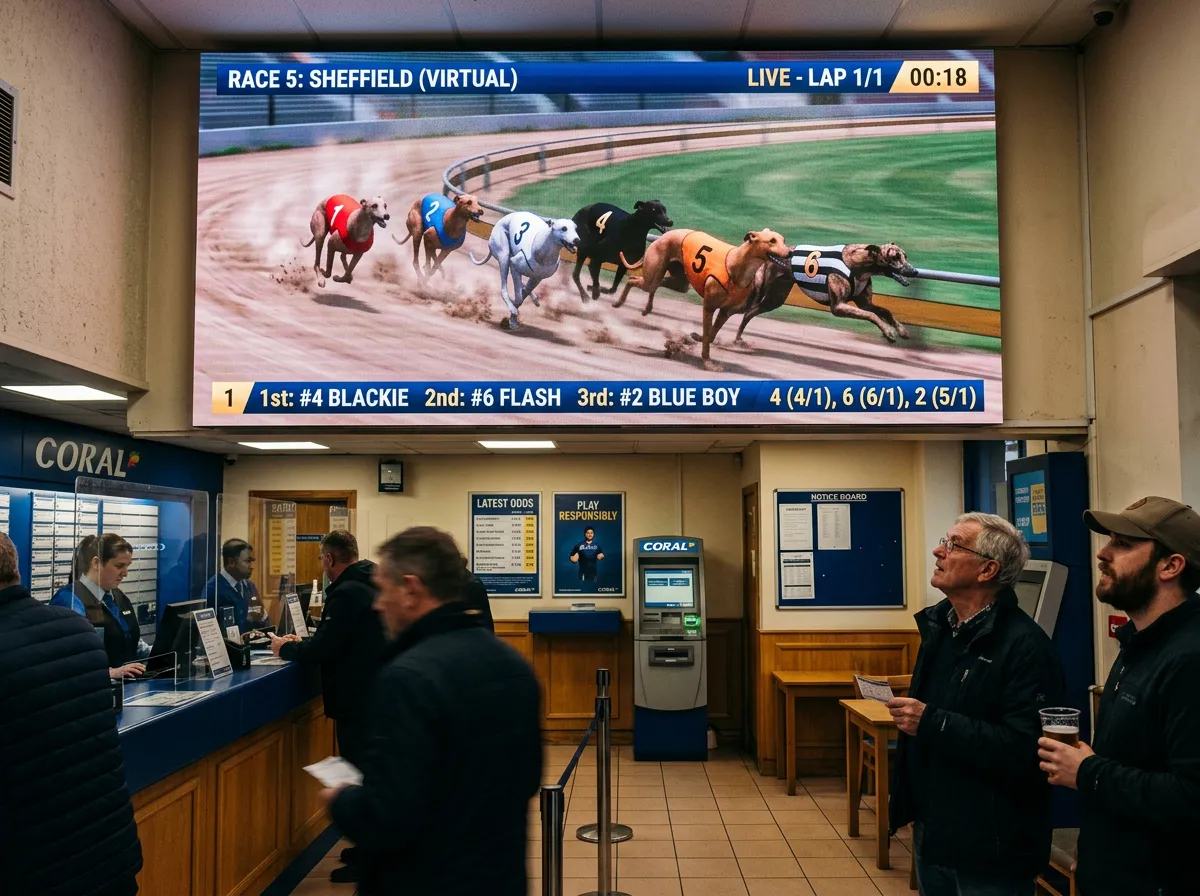
Virtual Greyhound Races Use Random Number Generators — Not Form
A bettor messaged me last year asking which trap had the best win rate in virtual greyhound racing. The honest answer is: none of them, and the question itself reveals a fundamental misunderstanding of what virtual racing is. NSoft launched AI-driven virtual greyhound races in 2025 with sophisticated animation and behaviour modelling, but beneath the visual polish, every outcome is determined by a random number generator. There is no form, no trap bias, no trainer influence and no track conditions. There is a computer deciding the result before the animated dogs leave the traps.
Understanding this distinction is critical because virtual greyhound racing is increasingly presented alongside live racing on betting platforms, and the visual similarity encourages bettors to apply the same analytical approaches to both. They are fundamentally different products — one rewards analysis, the other does not — and confusing them is an expensive mistake.
See also: how to win greyhound betting — comprehensive greyhound betting tips.
The Technology Behind Virtual Greyhound Racing
Virtual greyhound races use certified random number generators (RNGs) to determine the finishing order before the animation begins. The RNG produces a result, and the graphical engine then creates a race that matches that result — the animated dogs speed up, slow down, jostle and cross the line in an order that was decided before the race started. The animation exists for entertainment; the outcome is predetermined by mathematical randomness.
The global online betting market is projected to grow at a CAGR of 11.6% from 2023 to 2030, and virtual sports are a significant driver of that growth. For bookmakers, virtual racing fills gaps in the live racing schedule — it runs 24 hours a day, every day, with no dependency on track availability, weather or animal welfare considerations. The product is scalable, consistent and profitable because the bookmaker controls the margin directly through the RNG probability settings.
Each virtual race is an independent event. The outcome of Race 1 has zero bearing on Race 2. There are no streaks, no patterns and no form to analyse. The RNG is audited by independent testing agencies to ensure the outcomes are genuinely random and that the stated return-to-player percentages are accurate. A properly certified virtual racing product is not rigged — it is random, which is a different thing entirely. Rigged implies unfairness; random implies unpredictability.
The sophistication of modern virtual racing animation can be misleading. When you see a virtual greyhound slow down through the bends or accelerate on the run-in, it looks like real racing behaviour. It is not. It is a visual interpretation of a result that has already been calculated. The animation team at NSoft has done excellent work in creating lifelike behaviour, but the realism is aesthetic, not analytical.
Why Form Analysis and Trap Bias Have Zero Relevance to Virtual Races
In live greyhound racing, trap 1 has a win rate of approximately 18-19% because of the geometric advantage at the first bend. In virtual racing, every trap has the same probability of winning because the RNG assigns outcomes without reference to spatial geometry. The bookmaker’s overround on a virtual six-dog race is typically around 125% — similar to live racing — but there is no way to overcome it because there is no analytical edge to exploit.
Let me be direct about what this means for any bettor who has developed skills in live greyhound analysis. Your ability to read form is irrelevant. Your trap bias data is irrelevant. Your understanding of running styles, grade movements, trainer form, sectional times and track conditions is irrelevant. Virtual greyhound racing nullifies every analytical tool in your kit because the outcomes are not influenced by any of these factors. The RNG does not know what a trap draw is.
The bookmaker’s margin on virtual racing is fixed and unbeatable over the long term. In live racing, a skilled bettor can identify selections where the true probability exceeds the implied probability in the odds — the foundation of value betting. In virtual racing, the true probability is whatever the RNG is programmed to deliver, and the odds are set to ensure the bookmaker retains its margin regardless of which virtual dog you back. There is no information asymmetry to exploit because there is no information.
Real Racing vs Virtual: A Bettor’s Comparison
Jim O’Brien, a veteran of the greyhound industry, once reflected that the world simply changes. Virtual racing is one of those changes — a product that mimics live racing visually but operates on completely different principles. For bettors deciding where to invest their time and money, the comparison matters.
Live greyhound racing rewards investment. Hours spent studying form, tracking trainer records and building trap bias databases create a genuine informational edge. The market is inefficient enough — favourites win only 33% of graded races, and the bookmaker’s pricing is not perfectly efficient — that disciplined analysis can overcome the overround over time. The edge is narrow, it requires patience, and it demands rigorous record-keeping, but it exists.
Explore greyhound racing data and API betting.
Virtual racing rewards nothing except luck. A bettor spending ten hours analysing virtual racing data will have exactly the same expected return as one who picks numbers at random. The time investment has zero return because the data contains no predictive information. Every virtual race is a fresh dice roll with a built-in house edge.
The behavioural risk of virtual racing is significant for greyhound bettors. Virtual races run every 2-3 minutes, 24 hours a day. The speed and availability create a rhythm that can draw bettors into extended sessions, particularly during losing streaks when the urge to recover is strong. Live racing has natural breaks — meetings end, cards finish, tracks close for the night. Virtual racing never stops, and the absence of natural stopping points makes it easier to chase losses in a way that a structured live racing schedule discourages.
If you are serious about greyhound betting as an analytical pursuit, virtual racing is a distraction that offers no return on your skills. It exists as an entertainment product with a fixed house edge, similar to a slot machine with a greyhound-shaped interface. The money and time you invest in live racing analysis is the only path to sustainable results, and keeping that investment separate from virtual products protects both your bankroll and your approach to profitable betting.
