
Greyhound Ante Post Betting: Finding Value in Early Prices for Major Events
 Available in US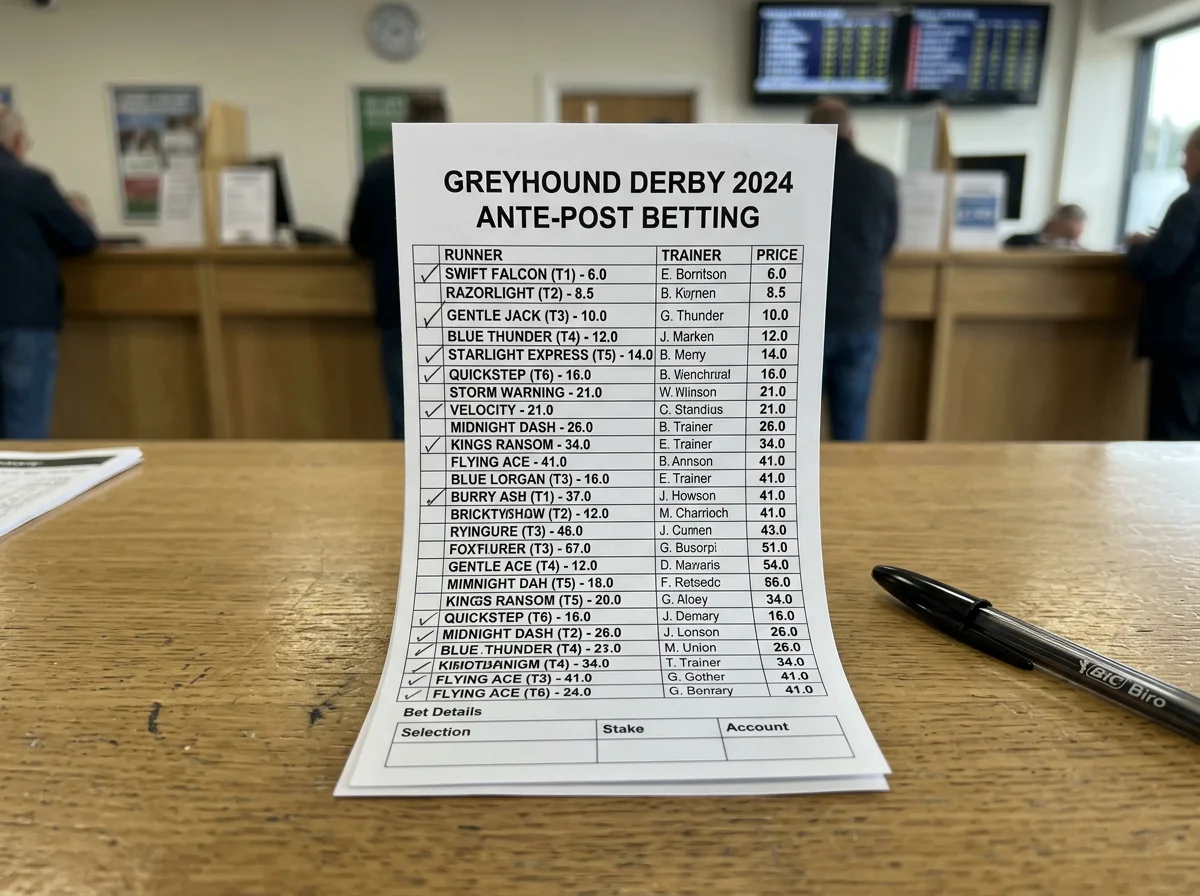
Ante Post Prices on Greyhounds Move Further Than Most Bettors Expect
I backed a dog for the English Greyhound Derby at 33/1 three weeks before the first round. By the time it reached the semi-finals, the price had contracted to 5/1. The dog did not win the final, but that price movement illustrates the core appeal of ante post greyhound betting: early prices carry inefficiencies that day-of-race markets have already corrected. Total UK greyhound prize money exceeds 15 million pounds annually, concentrated in the major events that generate the most betting interest — and the most volatile ante post markets.
Ante post betting is not for every greyhound punter. It ties up your stake for days or weeks, carries non-runner risk, and demands a different kind of analysis from the race-day form study that most of this site focuses on. But for bettors willing to accept those trade-offs, the value available in early greyhound markets can significantly exceed anything available on the day of the race.
See also: how to win greyhound betting — your greyhound betting resource.
How Ante Post Greyhound Betting Differs From Day-of-Race Wagers
Day-of-race greyhound betting is reactive. You see the card, assess the form, check the trap draw and bet within minutes of the off. Ante post betting is speculative by comparison — you are assessing a dog’s chance in a race that may be weeks away, against a field that may not yet be confirmed, on a card that has not been drawn.
The key mechanical difference is that ante post bets are typically “all in, run or not.” If your selection does not make the final, is withdrawn due to injury, or fails to qualify through the rounds, your stake is lost. There is no refund. This non-runner risk is the price you pay for access to early odds that reflect the market’s uncertainty. UK greyhound betting turnover of approximately 1.5 billion pounds in 2022-23 is overwhelmingly concentrated on day-of-race betting; ante post markets are a fraction of that volume, which means they attract less money, less scrutiny and less efficient pricing.
Bookmakers price ante post greyhound markets with wider margins than day-of-race markets because the uncertainty is greater and the liability is harder to manage. Paradoxically, this wider margin can coexist with individual prices that represent genuine value. A bookmaker might offer 20/1 on a dog whose true chance is 12/1 — a massive value overlay — while simultaneously building enough margin across the rest of the field to protect their overall position. The bettor who identifies that specific mispricing benefits even though the market as a whole favours the bookmaker.
Balancing Value Against Non-Runner Risk in Ante Post Markets
The non-runner question is the central tension in ante post greyhound betting, and it is the reason most bettors avoid the market entirely. But avoiding it means forfeiting the largest price discrepancies available in greyhound betting. The question is not whether non-runner risk exists — it does — but whether the value in the price adequately compensates for it.
Consider a dog priced at 16/1 ante post for a competition where it must win two qualifying rounds to reach the final. If you assess its true chance of winning the final at 8/1, the ante post price offers double the value. But the dog must survive two rounds first. If the probability of reaching the final is 50% (accounting for injury, poor draws and qualifying losses), then the adjusted probability of winning the competition is half your assessed 8/1 chance — roughly 16/1. The ante post price of 16/1 now offers no value at all once non-runner risk is factored in.
This calculation is the discipline that separates profitable ante post bettors from hopeful ones. You need to assess both the probability of winning the competition and the probability of reaching the point where winning is possible. Only when the ante post price exceeds both assessments combined does the bet carry genuine expected value.
I apply a simple rule: the ante post price must be at least 50% higher than my assessed day-of-race price to justify the non-runner risk. If I think a dog would be 6/1 on the day of the final, I need at least 9/1 ante post to take the bet. If I assess it at 10/1 for the final, I need 15/1 or better. This threshold is conservative, and it means I pass on most ante post opportunities. The ones I do take have a built-in buffer against the uncertainty that makes ante post betting inherently riskier than day-of-race wagering.
Key UK Greyhound Events With Active Ante Post Markets
Not all greyhound events generate ante post markets. Bookmakers typically offer early prices on the sport’s flagship competitions, where public interest and betting volume justify the market creation. Dunstall Park recorded a 324% increase in attendance for the Premier Greyhound Racing Oaks final compared to 2024, demonstrating the pulling power of these marquee events.
Learn about forecast betting in greyhound racing.
The English Greyhound Derby is the sport’s most prestigious competition and attracts the deepest ante post market. Prices appear weeks before the first round, and the market evolves through the qualifying stages as dogs are eliminated and the field narrows. The Derby’s multi-round format creates natural price inflection points — a dog that wins its first-round heat impressively will shorten significantly, while one that qualifies narrowly or unconvincingly may drift.
Other events that regularly generate ante post betting interest include the Scottish Greyhound Derby, the Irish Greyhound Derby (for bettors with access to cross-border markets), and the various category races at major UK venues such as the Oaks, the St Leger and the Grand Prix events at individual tracks. The depth and availability of these markets varies by bookmaker, and not all operators offer ante post greyhound betting as a standard product.
The timing of your ante post bet matters. Prices are widest — and therefore potentially most generous — when the market first opens, before any qualifying rounds have been run. As the competition progresses and the field shrinks, the market tightens and the pricing becomes more efficient. Early bets carry more non-runner risk but access the widest prices. Later bets carry less risk but sacrifice price advantage. Finding the right balance between price and certainty is the practical skill of ante post value betting on greyhounds.
One final consideration: ante post stakes should be a small proportion of your overall greyhound betting bankroll. The non-runner risk means a higher proportion of these bets will result in total stake loss compared to day-of-race wagers. I allocate no more than 10% of my monthly greyhound betting budget to ante post positions, and each individual ante post bet is sized at half my standard unit stake. This ensures that the inevitable dead-heat of non-qualifiers and withdrawn runners does not materially damage my bankroll while preserving access to the value that early markets occasionally offer.
