
How Track Conditions Affect Greyhound Racing Results and Trap Bias
 Available in US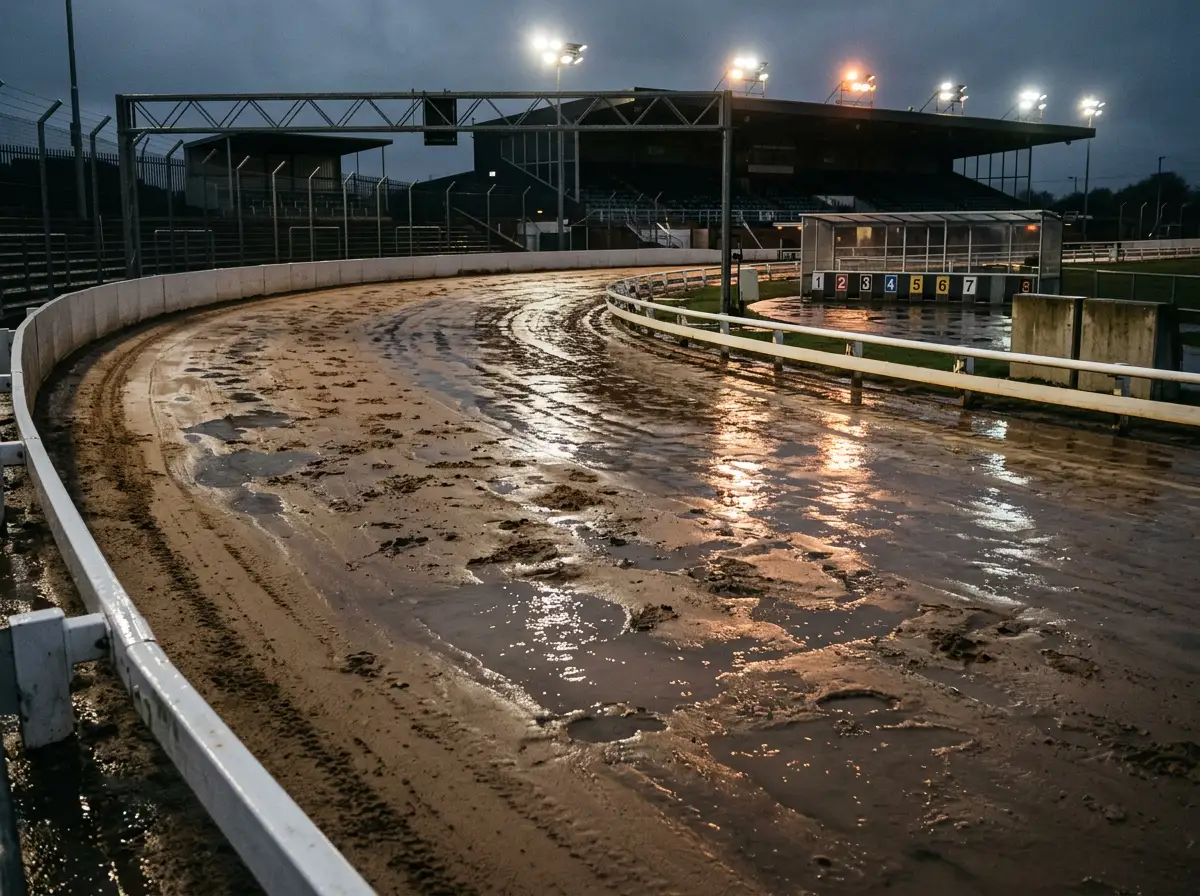
Why the Same Dog Performs Differently on Wet and Dry Tracks
I once backed a dog at Romford that had won its previous three races on dry evenings, all in sub-29.50 times. It rained heavily that afternoon, the track was soaked, and the dog finished last. The same greyhound, the same trap, the same grade — and a completely different result. Track conditions changed everything, and I had not adjusted my assessment by a single percentage point.
Greyhound racing surfaces are not standardised the way a football pitch is. Conditions shift with weather, time of day, maintenance schedules and even the number of races already run on the card. A dog’s paws interact with the surface differently when it is wet versus dry, compacted versus freshly raked. The traction available at the first bend — where trap 1 typically carries a win rate advantage of 18-19% against the theoretical 16.6% — changes with moisture levels. These are not marginal effects; they can swing the outcome of an entire meeting’s results.
Understanding how conditions affect your selections is not optional if you are betting seriously across the 18 GBGB-licensed venues in the UK. Each track responds differently to weather because each track has a different surface composition, drainage system and exposure to wind and rain. What holds true at Sunderland in a downpour does not necessarily hold at Towcester in the same conditions.
See also: how to win greyhound betting — everything about greyhound racing betting.
Sand, Boylesports and Synthetic Surfaces: How Material Affects Pace
The first thing any greyhound bettor should know about UK tracks is that they do not all use the same surface. Most licensed venues run on sand-based surfaces, but the composition varies — some use fine-grain sand, others coarser blends with different drainage properties. A few venues have experimented with or adopted synthetic or modified surfaces that aim to provide more consistent running conditions regardless of weather.
Sand surfaces are the traditional standard and remain dominant across the UK. On dry sand, the surface is firm and fast, producing quicker times and favouring dogs with explosive early pace. The footing is reliable, and dogs can generate maximum traction through the bends. On wet sand, the surface softens, slowing overall times by half a second or more over a standard 480-metre race. Softer ground also reduces the traction advantage at the bends, which can narrow the inside trap bias as outside runners lose less momentum through the turns.
Heavier surfaces favour different running styles. A powerful dog with a strong galloping action can handle soft ground better than a lightweight sprinter that relies on firm footing for its turn of speed. Weight becomes a factor here: heavier greyhounds (33kg and above) tend to manage wet surfaces more effectively than lighter dogs (under 29kg) because their greater mass provides more ground contact and stability.
Synthetic and modified surfaces aim to minimise the impact of weather by providing consistent drainage and surface firmness. Where these surfaces are used, the time differential between wet and dry conditions is smaller, making form comparison between meetings more reliable. The trade-off is that some dogs simply do not handle the feel of synthetic surfaces as well as sand, which introduces another selection variable.
Rain, Heat and Wind: Measurable Effects on Race Outcomes
Beyond surface type, three weather factors measurably influence greyhound race results, and each affects the racing dynamic differently.
Rain is the most impactful. Heavy rain during a meeting changes conditions race by race — the track deteriorates as more races are run on it, with the inside rail typically cutting up faster than the outside because front-runners and rail dogs churn the surface along the shortest path. By the later races on a wet card, the inside ground can be significantly worse than the outside, potentially inverting the usual trap bias. I have seen meetings where trap 1 dominated the early races on a drying track and trap 5 or 6 came into its own for the last three races as the inside rail deteriorated.
Heat affects the surface in the opposite direction. Warm, dry conditions firm up the ground and can make it hard and fast, favouring quick-breaking dogs with early pace. Extreme heat — rare in the UK but not unknown during summer evening meetings — can also affect the dogs themselves, with some greyhounds performing below their best in high temperatures. Track managers may water the surface before evening meetings on hot days, which can produce inconsistent conditions across different sections of the track.
Wind is the most underestimated weather factor. A strong headwind on the back straight slows all dogs, but it disproportionately affects front-runners who are exposed to it without the shelter of the pack. Closers running in behind benefit from drafting and can overhaul leaders who would normally maintain their advantage on a calm evening. Crosswinds at the bends can push dogs off their preferred running line, creating interference patterns that the form book cannot predict.
Adjusting Your Selections for Changing Track Conditions
Knowing that conditions matter is one thing. Adjusting your betting in response is where the edge materialises. Here is the practical framework I use, built from tracking results across varying conditions over several seasons.
Before any meeting, I check the weather forecast for the track’s location, not just the general region. Microclimates exist — a coastal track like Sunderland can be dry while an inland venue an hour away is under heavy rain. I note whether the meeting is afternoon or evening, because afternoon meetings in summer face different temperature conditions than evening cards.
Learn about BAGS racing betting for greyhounds.
If rain is forecast or has already fallen, I shift my trap-bias expectations. The standard inside-trap advantage diminishes on wet surfaces, and dogs drawn in traps 3 and 4 — the middle positions — can benefit from cleaner ground that has not been churned by rail runners or pushed wide by outside dogs. I also upgrade heavier dogs and downgrade lightweight sprinters whose form was built on firm going.
For hot, dry conditions, I lean toward confirmed front-runners from inside traps. The firm surface enhances early speed, and the inside rail holds up well on dry ground, maintaining the geometric advantage that normally favours trap 1. Dogs with strong first-sectional times in their recent form become even stronger propositions when the surface is fast.
The favourite win rate of around 33% in graded racing is an average that spans all conditions. On meetings where conditions strongly favour a particular profile — inside-drawn front-runners on dry tracks, or wide-running stayers on wet tracks — the actual favourite win rate for that meeting can deviate significantly from the average. Recognising when conditions are likely to produce above-average or below-average favourite success helps calibrate your staking and selection for the specific evening, rather than relying on annual averages that may not reflect what is happening on the ground.
The simplest adjustment most bettors can make is to reduce their overall activity on meetings where conditions are extreme or changing rapidly. A track that is transitioning from dry to wet during a meeting is the hardest to read, because each race runs on a slightly different surface. On those evenings, I bet fewer races and size my stakes conservatively, accepting that the uncertainty is genuine and cannot be fully resolved by analysis.
