
Greyhound Betting for Beginners: Your First Bet From Start to Finish
 Available in US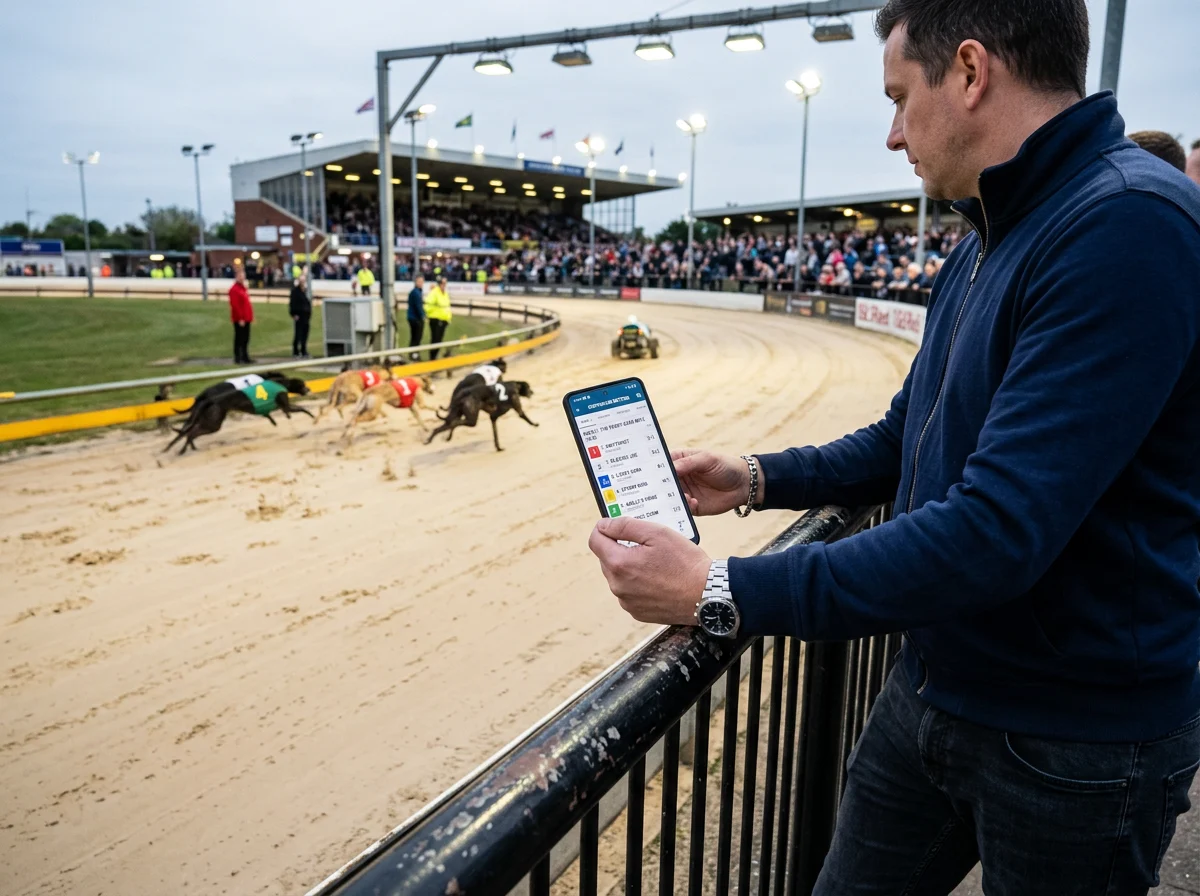
What Makes Greyhound Betting Different From Other Racing
When I moved from horse racing to greyhounds, I assumed the basics were the same. Pick a runner, place a bet, watch the race. The mechanics are similar, but the dynamics are completely different, and those differences matter from the very first bet you place.
Every greyhound race has exactly six runners. No withdrawals at the start, no last-minute non-runners reshuffling the odds. You are choosing from six dogs, every time. This simplicity is deceptive — it makes the racing feel more predictable, but in practice, six-runner fields produce tight finishes and frequent upsets. Approximately 25,000 BAGS races are staged each year across the UK’s 18 GBGB-licensed stadiums, plus open and evening fixtures. The volume of racing is enormous, with meetings running most afternoons and evenings throughout the week.
The other fundamental difference is speed. A greyhound race over 480 metres lasts about 29-30 seconds. Horse races can run for several minutes. In greyhound racing, a slow break from the traps or a bump at the first bend can decide the race in the first five seconds. There is almost no time to recover from a poor start, which is why early pace and trap draw dominate the analysis in a way that has no equivalent in horse racing.
Understanding these structural differences before you place your first bet sets the right expectations. Greyhound racing is fast, high-frequency and punchy — and it rewards bettors who respect its particular dynamics rather than importing assumptions from other sports.
See also: how to win greyhound betting — expert tips for greyhound racing.
Win, Place and Each-Way: The Three Bets Every Beginner Needs
You do not need to learn twenty bet types before placing your first greyhound wager. Three will serve you well for months, and they cover nearly every situation a beginner encounters.
A win bet is the simplest: you back a dog to finish first. If it wins, you collect at the offered odds. If it finishes second or worse, you lose your stake. The beauty of a win bet is its clarity — there is no ambiguity about the outcome, and the odds directly reflect the bookmaker’s assessment of that dog’s winning chance.
A place bet backs your selection to finish in the top two (first or second). The odds for place betting are shorter than win odds because you are covering two outcomes instead of one. Favourites win roughly 33% of graded greyhound races, but they finish in the first two considerably more often. Place betting is lower risk and lower reward, but for a beginner learning to read form and assess fields, it provides a gentler introduction than win-only betting where two-thirds of your bets are expected to lose.
An each-way bet combines both: half your stake on the win, half on the place. At a 2-pound each-way stake, you are betting 2 pounds to win and 2 pounds to place, for a total outlay of 4 pounds. If the dog wins, you collect both the win and place components. If it finishes second, you lose the win stake but collect the place return at a fraction of the win odds (typically one-quarter in greyhound racing). Each-way bets work best on dogs priced at 5/1 or above, where the place component produces a meaningful return.
Placing Your First Greyhound Bet Online: A Step-by-Step Walkthrough
Mobile betting accounts for more than 70% of all greyhound wagers in modern markets, so your first bet is almost certainly going to be placed on a phone or laptop rather than at a track. The process is straightforward, but a few details trip up newcomers.
Once you have an account with a licensed bookmaker, navigate to the greyhound racing section. Meetings are listed by time and track — you will see something like “19:32 Romford” or “14:15 Sunderland.” Click into a meeting to see the card: six dogs listed by trap number (1 through 6), each with the dog’s name, trainer, weight, recent form figures and offered odds.
Read the form figures first. They show the finishing positions in the dog’s most recent races, with the latest run on the right. A form line of “3-2-1-4-1” tells you this dog won its last race and its third-most-recent, finished second once and third once, with a fourth-place finish in between. Numbers are positions; letters indicate specific incidents (for instance, “F” for fell, “T” for trapped). As a beginner, focus on dogs that have been consistently finishing in the first three positions.
Select the dog you want to back by tapping its odds. The selection appears in your bet slip. Choose your bet type (win, place or each-way), enter your stake, and confirm the bet. That is it. The race will appear in the live schedule, and results are usually available within seconds of the finish.
One practical tip: set a budget for your first meeting. Decide before you start how much you are prepared to spend across the entire card, and divide that into individual stakes. A 20-pound budget across eight races means roughly 2.50 per race — small enough to learn without financial stress, large enough to take seriously.
Four Common Beginner Mistakes and How to Avoid Them
I made all four of these mistakes in my first month of greyhound betting. Each one is avoidable if you know what to watch for.
The first mistake is betting every race on the card. Greyhound meetings run 8-12 races, and the temptation to have a bet on each one is powerful, especially when races come every twelve minutes. But betting every race means you are paying the bookmaker’s overround — approximately 25% on a six-dog field — on every single race. Selective betting, where you identify two or three races with a clear opinion and skip the rest, reduces your exposure to that margin.
Learn how to read a greyhound race card.
The second mistake is chasing losses. You back two losers and decide to double your stake on the third race to recover. This is the road to finishing the evening with an empty wallet. Losses are a normal part of greyhound betting — favourites win only a third of the time, so two consecutive losing bets is statistically expected, not unusual. Your stake should be flat: the same amount on every race you bet, regardless of what happened in the previous race.
The third mistake is ignoring the trap draw. Beginners tend to focus on the dog’s name, recent form or the trainer, without considering where the dog starts. Trap position matters in greyhound racing more than in almost any other sport. Trap 1 has a statistically higher win rate (18-19% vs the theoretical 16.6%) because of the geometric advantage at the first bend. A dog with strong form from an outside trap is a different proposition from the same dog drawn inside.
The fourth mistake is betting at short prices without understanding value. A dog at 4/6 (implied probability 60%) needs to win 60% of its races to break even. That is a very high bar. Beginners are drawn to short-priced favourites because they feel safer, but the mathematics often make them the worst value on the card. Before backing any dog, ask yourself: does this dog win often enough at this price to produce a profit? If you cannot answer that question with evidence from the form, the bet is a guess, and guesses at short odds are expensive.
The good news is that greyhound racing is one of the most learnable betting markets. Six runners, consistent race formats, abundant data and high-frequency meetings mean you accumulate experience quickly. Building a structured approach from the start — budget, selectivity, flat staking, basic form reading — puts you ahead of the majority of casual bettors from day one.
