
Greyhound Betting Exchange vs Bookmaker: Which Gives You Better Odds
 Available in US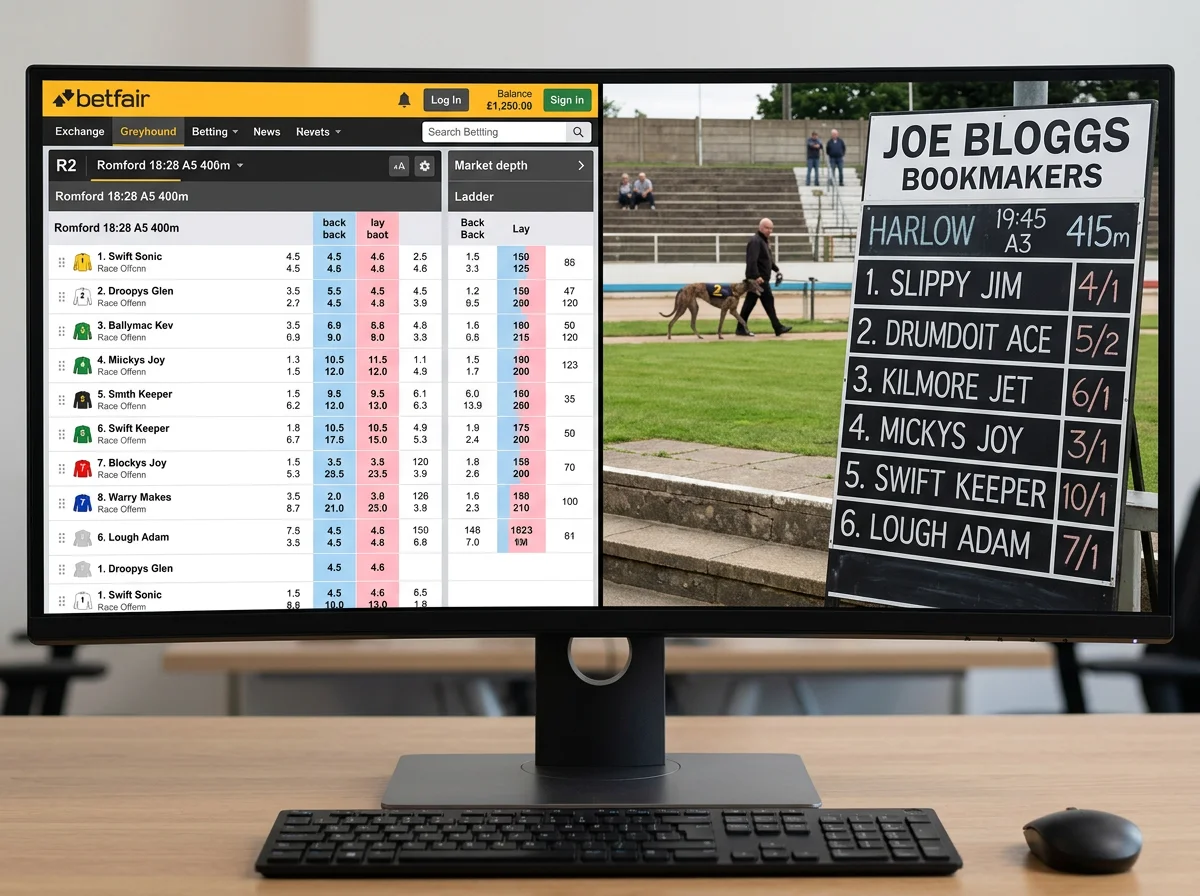
Two Markets, Different Margins: Exchange vs Bookmaker Pricing
I spent three years betting exclusively with traditional bookmakers before opening an exchange account. Within a month, I realised I had been overpaying for every greyhound bet I had ever placed. The difference was not dramatic on any single bet, but over hundreds of selections, it was the difference between a marginal loss and a marginal profit.
The core distinction is structural. A bookmaker sets odds to guarantee a profit margin — the overround, which on a typical six-dog greyhound race sits at roughly 125%. The bookmaker prices all six runners so that the sum of implied probabilities exceeds 100%, pocketing the excess regardless of the result. An exchange operates differently: it matches backers with layers (people willing to bet against a dog), taking a commission on net winnings rather than building a margin into the odds. Exchange overrounds on greyhound markets typically run between 103% and 108%.
That gap — 125% versus 105% — represents the difference between paying a 25% implicit tax on every bet and paying roughly 5%. UK greyhound betting generated total turnover of approximately 1.5 billion pounds in 2022-23, and the vast majority of that money flowed through traditional bookmakers at the wider margin. Bettors who shifted even a portion of their activity to the exchange captured better prices on the same selections.
See also: how to win greyhound betting — greyhound betting insights and strategies.
How a Betting Exchange Works for Greyhound Markets
An exchange is a marketplace. You see two columns of prices for every dog: the back price (the odds you can bet at if you think the dog will win) and the lay price (the odds you can accept if you think it will lose). The back price is always slightly lower than the lay price — that spread is how the exchange maintains a functional market.
When you place a back bet on the exchange, your bet is matched against someone else’s lay bet. If no one is willing to lay at your desired price, your bet sits unmatched until either the price moves to your level or the race starts. This matching mechanism means you are not betting against the house; you are betting against other punters. The exchange takes no risk on the outcome — it simply facilitates the transaction and charges commission, typically 2-5% of your net profit.
For greyhound bettors accustomed to bookmaker pricing, the exchange experience feels different. Prices fluctuate constantly as money enters the market. A dog might be 3.5 on the exchange at 19:00 and 3.0 by 19:10 as backers push the price in. This volatility creates opportunities — you can request a price that is not currently available and wait for the market to move to you. With bookmakers, you take the price on offer or leave it.
One practical advantage of exchanges for greyhound betting is the ability to trade positions. If you back a dog at 4.0 and the price shortens to 3.0 before the race, you can lay it at 3.0 to lock in a profit regardless of the result. This “green book” trading is not available with traditional bookmakers and adds a strategic dimension that some greyhound bettors find more engaging than straightforward backing.
Comparing Real Odds: Exchange Prices vs Bookmaker SP
Theory is one thing; actual prices are another. I tracked the exchange back price at the off against the bookmaker starting price for 200 greyhound races across four tracks over two months. The results confirmed what the margin difference predicts: exchange prices were, on average, 8-12% better than bookmaker SP.
The advantage was not uniform. On short-priced favourites (under 2.0), the exchange and bookmaker prices were often very similar — the bookmaker knows these dogs attract volume and prices them competitively. The biggest discrepancies appeared on mid-range dogs (3.0 to 6.0 on the exchange) where the bookmaker’s overround compression was most aggressive. A dog at 4.0 on the exchange might be 7/2 (4.5 decimal) with the best bookmaker — a significant difference over hundreds of bets.
The annual off-course greyhound betting turnover in GB reached nearly 740 million pounds in the April 2021 to March 2022 period, most of it at bookmaker prices. The minority of bettors using exchanges for their greyhound wagers were consistently securing better value on identical selections. Over a year of regular betting, that persistent price advantage compounds into a meaningful difference in returns.
Where the bookmaker occasionally beats the exchange is on promotional offers — enhanced odds on specific races, best-odds-guaranteed commitments, or money-back specials. These promotions can offer headline prices that exceed exchange levels on individual bets. However, they come with conditions and limits that reduce their long-term value, and they are designed as customer acquisition tools rather than sustained pricing advantages.
Liquidity Challenges in Greyhound Exchange Markets
Here is the catch, and it is a real one: greyhound exchange markets are thin. The liquidity available — the amount of money waiting to be matched at any given price — is a fraction of what you find on horse racing or football exchanges. This thinness creates practical problems that limit how much of your greyhound betting can move to the exchange.
Discover lay betting strategies for greyhound racing.
On a typical BAGS afternoon meeting, you might see only 50-100 pounds available at the best back price on each runner. If you want to stake 20 pounds, that is manageable. If you want to stake 100 pounds, you will move the price against yourself by consuming the available money at the best level and being matched at worse prices. For serious-stakes bettors, the exchange simply cannot absorb their volume on lower-profile meetings.
Evening meetings and feature events attract significantly more exchange liquidity. Saturday evening open races at major tracks might have several hundred pounds available at the top prices, making larger stakes feasible. The liquidity follows the profile and televised coverage of the meeting — more viewers mean more exchange participants.
My practical approach is to split my greyhound betting between exchange and bookmaker based on the meeting profile. For featured evening meetings with adequate exchange liquidity, I back on the exchange and accept the better odds. For afternoon BAGS meetings where exchange liquidity is limited, I use bookmakers but shop across multiple accounts for the best available price. This hybrid approach captures the exchange advantage where it exists without sacrificing execution quality on thinner markets.
One technical point worth noting: exchange prices on greyhounds can move sharply in the final two minutes before a race, as the bulk of the money arrives late. If you are a regular exchange bettor, developing a feel for the timing of these late movements at your target tracks helps you secure better prices by placing bets just before the major liquidity surge rather than after it.
