
Best Greyhound Betting Sites: What to Compare Beyond Welcome Offers
 Available in US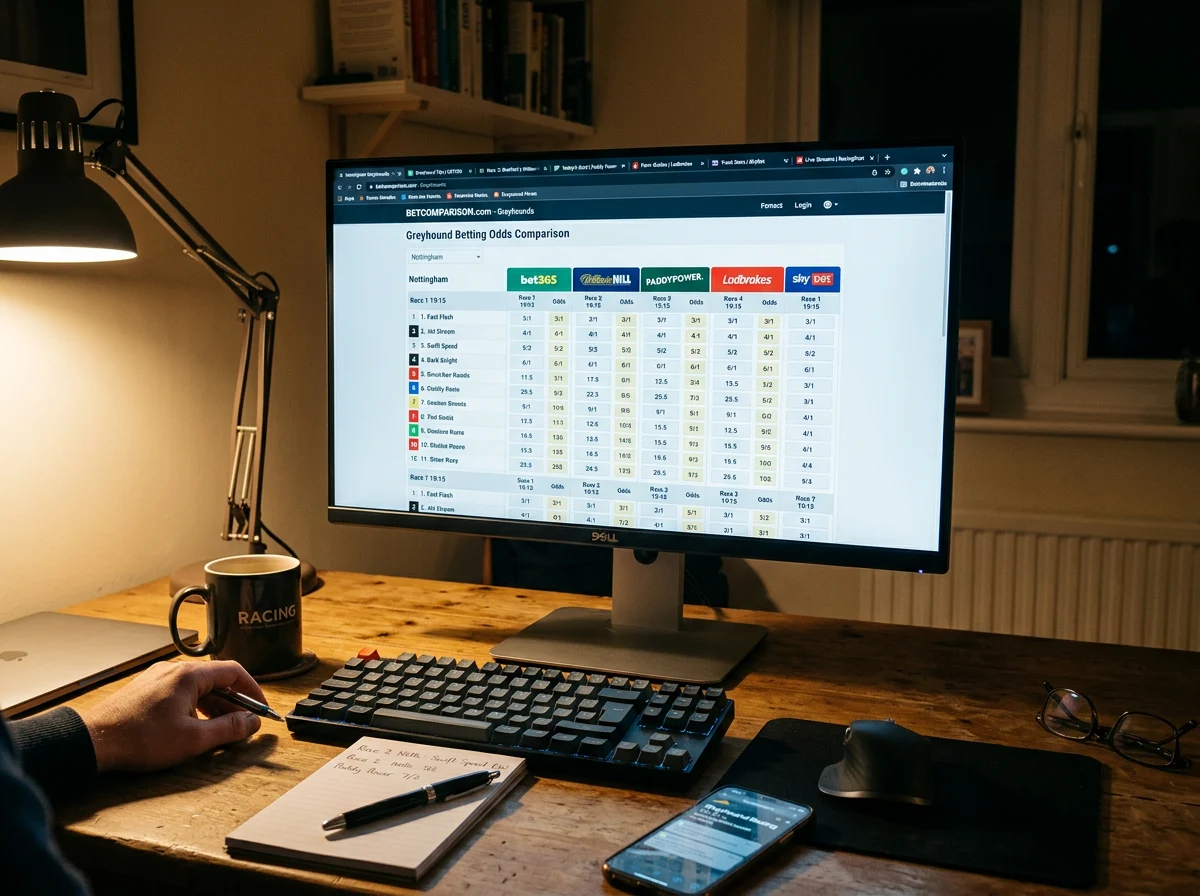
Why Your Choice of Bookmaker Affects Greyhound Betting Returns
I used a single bookmaker for my first four years of greyhound betting because it was the account I already had from football season. It was convenient and familiar. It also cost me roughly 3-4% of turnover compared to what I would have earned taking the best available price across multiple operators. On UK greyhound betting turnover of approximately 1.5 billion pounds annually across the industry, those percentage points translate into enormous sums at the aggregate level — and they matter just as much at the individual level.
The bookmaker you use is not a neutral variable. Different operators price greyhound markets differently, offer different place terms on each-way bets, apply different restrictions to winning accounts, and provide different levels of market coverage. A dog priced at 7/2 with one operator might be 4/1 with another. Over a year of regular betting, consistently taking the worse price adds up to a measurable drag on returns that no selection method can overcome.
Choosing where to bet is as much a strategic decision as choosing what to bet on. The two are connected: the best selection in the world loses value if it is backed at the wrong price.
See also: how to win greyhound betting — the greyhound betting guide.
Six Factors That Matter More Than Bonus Size
Welcome bonuses dominate the comparison conversation, but for a greyhound bettor who plans to bet regularly for months or years, the ongoing terms of the account matter far more than the introductory offer. Here are the six factors I evaluate, in order of importance.
Odds competitiveness across greyhound markets is the single most important factor. Some operators consistently offer longer prices on greyhound runners; others are systematically tight. The only way to assess this is to compare live odds across several operators on the same races over a period of weeks. Price comparison tools help, but checking manually for your specific target tracks and race types gives a more accurate picture. The bookmaker’s overround on a six-dog race is typically around 125%, but it varies between firms, and firms with lower overrounds return more money to bettors over time.
Market depth is the second factor. Does the operator offer early prices on greyhound meetings, or only starting-price betting? Can you bet on BAGS afternoon racing as well as featured evening meetings? Are ante-post markets available for major events? A bookmaker that covers only evening meetings is useless for a bettor who specialises in afternoon BAGS racing.
Each-way terms come third. Standard greyhound each-way terms are 1/4 odds on the first two finishers, but some operators offer enhanced place terms on selected meetings. Over hundreds of each-way bets, better place terms compound into a meaningful advantage.
Best Odds Guaranteed (BOG) policies vary significantly. Some operators offer BOG on all UK greyhound racing; others exclude certain meetings or apply it only to races shown on particular broadcasters. Grainne Hurst, CEO of the Betting and Gaming Council, has highlighted the competitive pressures on licensed operators — BOG is one area where that pressure works in the bettor’s favour, but only if the policy genuinely covers the meetings you bet on.
Cash-out and partial cash-out features are the fifth factor. These allow you to close a bet before the race finishes, locking in a profit or cutting a loss. Not all operators offer cash-out on greyhound markets, and those that do may restrict it to certain bet types or meetings.
Account longevity — how long the operator tolerates profitable betting — is the sixth and most frustrating factor. It cannot be assessed in advance because restriction policies are not published. But it is real, and serious greyhound bettors manage it by maintaining multiple accounts and distributing their betting activity across several operators.
Why Serious Greyhound Bettors Use Multiple Accounts
Off-course greyhound betting in GB generated nearly 740 million pounds in turnover during the 2021-22 financial year, spread across dozens of licensed operators. Serious bettors exploit this fragmented market by maintaining accounts with several operators and taking the best available price on every selection.
The practical benefit is straightforward: better odds on every bet. If you back three greyhound selections per meeting at an average price improvement of 0.5 points (the difference between, say, 3/1 and 7/2), across 100 meetings per year, the cumulative impact on ROI is significant. This is not theoretical; it is the single easiest improvement most bettors can make.
The secondary benefit is resilience against account restrictions. When one operator limits your stakes, you have other accounts to fall back on. This is not a hypothetical concern — it is an inevitability for any bettor who sustains a profit. Spreading your volume across operators delays the point at which any single one identifies you as a winning customer.
Managing multiple accounts requires discipline. You need a system for comparing prices quickly before each bet, which means having the greyhound markets for your target meeting open simultaneously on different tabs or devices. Price comparison websites can help, though they sometimes lag behind live price movements. The overhead is real, but the return on that investment of time is among the highest available in greyhound betting.
Account Restrictions and How Greyhound Bettors Get Limited
Every winning greyhound bettor has been restricted by at least one bookmaker. Most have been restricted by several. This is not a conspiracy; it is a business model. Bookmakers identify customers whose betting patterns suggest sustained profitability and limit their maximum stakes, sometimes to as little as a few pence per bet — effectively closing the account without formally doing so.
The triggers for restriction vary but commonly include: consistently taking early prices that shorten significantly before the off, maintaining a high ROI over an extended period, regularly claiming Best Odds Guaranteed payouts, and concentrating bets on markets where the bookmaker’s margin is thinnest. Greyhound markets are particularly sensitive to these signals because the margins are already tight relative to the bookmaker’s risk.
Learn about tote betting in greyhound racing.
There is limited recourse once restricted. Some operators will negotiate a revised stake limit; most will not. The practical response is to accept restrictions as a cost of doing business, open accounts with other operators, and continue betting at the best available prices across your remaining active accounts.
One strategic consideration: the speed at which you are restricted correlates with the visibility of your betting pattern. Taking the best price across every meeting, on every race, at maximum stakes, flags you quickly. Being selective about which operators you use for which bets — saving your longest-odds operator for the most value-rich selections, using closer-priced operators for lower-edge bets — can extend the useful life of each account. It is an imperfect solution to a structural problem, but in a market where the odds landscape favours the informed bettor, account management is an unavoidable part of the game.
