
Greyhound BAGS Racing: How Daytime Fixtures Differ for Betting Purposes
 Available in US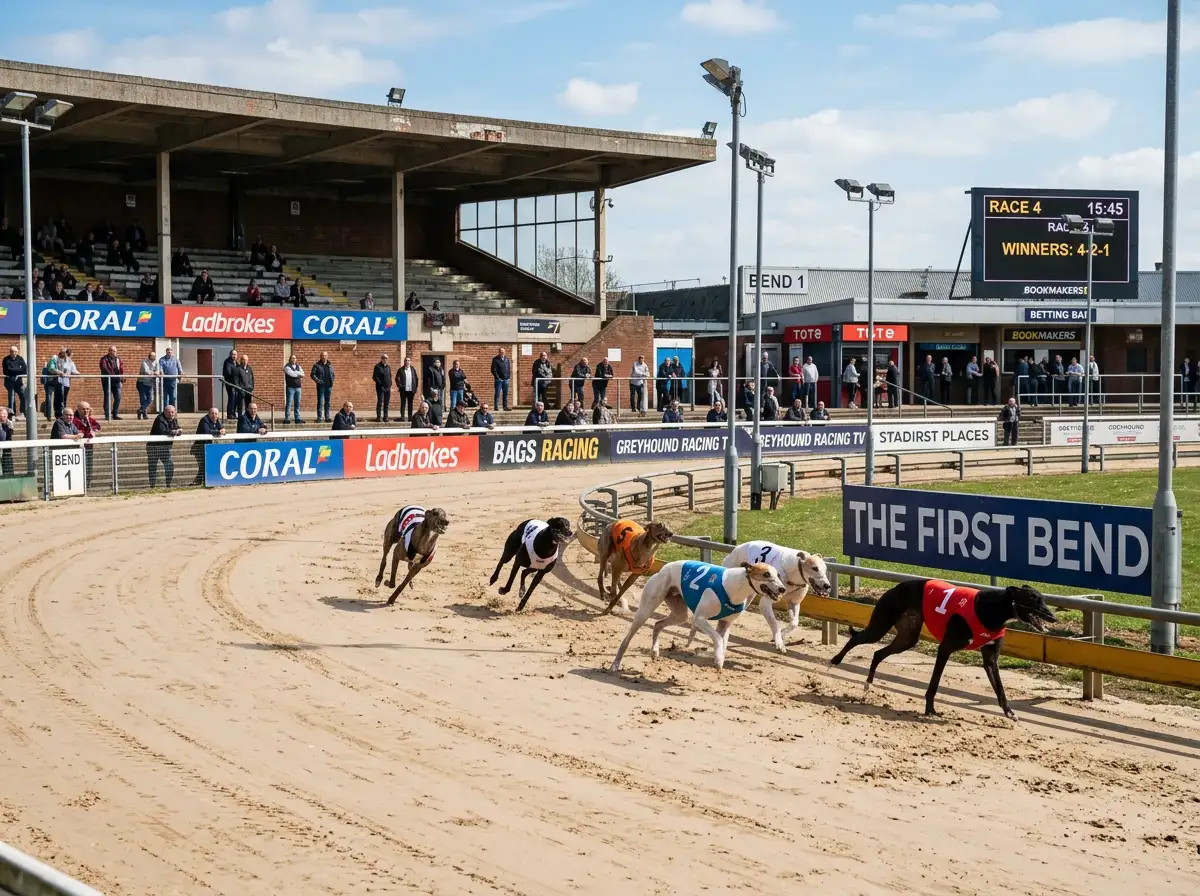
BAGS Races Dominate UK Greyhound Schedules — Here Is What Makes Them Different
If you bet on greyhounds with any regularity during the week, the vast majority of your wagers land on BAGS races. BAGS — the Bookmakers’ Afternoon Greyhound Service — generates approximately 25,000 races annually across the UK’s 18 GBGB-licensed stadiums, providing a near-continuous stream of racing content from late morning through to early evening. These fixtures exist primarily to give bookmakers a product to offer their customers during hours when horse racing is limited or absent.
I was betting BAGS meetings for over a year before I understood how fundamentally different they are from Saturday evening open racing. The competitive dynamics, the market efficiency, the grading patterns and the amount of informed money in the market all differ from featured evening fixtures. Treating BAGS races the same as premier meetings is a guaranteed way to miscalibrate your expectations and your staking.
See also: how to win greyhound betting — your complete guide to greyhound betting.
What BAGS Racing Is and How It Fills the Daily Betting Card
BAGS was established to serve bookmaker demand for betting content. The races are funded by bookmaker contributions, and the fixtures are scheduled to fill gaps in the daily racing calendar. Arena Racing Company operates many of the tracks hosting BAGS meetings, and Sarah Newman of Arena noted that competition for the leisure pound has never been higher — a pressure that extends to the BAGS product, which competes for betting spend against horse racing, virtual sports and in-play football.
The structure of a BAGS meeting is typically 8-12 races, spaced approximately 12-15 minutes apart, running from around 10:30 in the morning through to 16:00 or later. The races are overwhelmingly graded, meaning the fields are composed of dogs at similar competitive levels. Open races — the prestigious events that attract the sport’s best runners — are rare in BAGS schedules and are concentrated in evening and weekend cards.
BGRF collects 6.75 million pounds annually from voluntary bookmaker contributions, calculated at 0.6% of greyhound betting turnover. A significant portion of that turnover is generated by BAGS fixtures, making them financially critical to the industry even though they lack the profile and atmosphere of featured evening racing.
Competitive Quality: Grading, Field Strength and Predictability
The grading in BAGS races tends to produce tighter fields than evening meetings. Because the runners are all at similar levels within the grading structure, the margins between the best and worst dog in a race are narrower. This has a direct effect on predictability: upsets are more common in BAGS racing because there is less class separation to distinguish one runner from another.
Favourites in graded racing across the UK win approximately 33% of the time on average, but my observation — consistent with the broader data — is that BAGS favourites hit this mark less reliably than evening-meeting favourites. The combination of tighter fields, lower market attention and fewer informed bettors means the market is less efficient at identifying the correct favourite. In open races at major venues, where field quality is more clearly stratified, favourites can win up to 52% of the time. The gap between 52% and the BAGS average reflects the impact of competitive quality on predictability.
For the data-driven bettor, this inefficiency is an opportunity. BAGS meetings attract less sharp money, fewer professional bettors and thinner exchange liquidity. The odds are set with less precision because bookmakers dedicate fewer resources to pricing afternoon meetings than featured evening cards. That pricing softness means genuine value can exist at wider margins than you typically find in the evening.
The volume of BAGS racing also produces a larger sample for pattern detection. If you are building trap bias models or tracking trainer form at a specific track, afternoon meetings provide the bulk of the data. A venue running four BAGS meetings per week generates significantly more data points than one or two evening cards, allowing your statistical models to reach meaningful sample sizes faster.
Adjusting Your Approach for BAGS vs Open and Evening Racing
My approach to BAGS betting differs from my evening strategy in three specific ways, each calibrated to the characteristics of the product.
First, I increase my selectivity. With 8-12 races per meeting and meetings running at multiple tracks simultaneously, the volume of BAGS racing is enormous. Betting every race is a trap — the overround of roughly 25% applies to each one. On a BAGS afternoon, I typically identify one or two races where my analysis produces a clear opinion, and I skip everything else. The temptation to bet more, especially when races come every twelve minutes, is powerful and must be resisted.
Learn how track conditions impact greyhound betting.
Second, I weight trap draw and running style more heavily in BAGS races than in open races. In a field of evenly matched dogs, the positional factors become the decisive edge. A dog with a clear running style advantage from its trap draw — a railer in trap 1, a wide runner in trap 6 — has a measurable edge in a BAGS grade that it might not have in an open race where outright ability dominates. The 18-19% win rate for trap 1 versus the theoretical 16.6% is more exploitable in BAGS graded fields where the dogs are otherwise difficult to separate.
Third, I pay closer attention to trainer-track specialisation. BAGS meetings are often run at the same tracks day after day, and certain trainers dominate specific venues. A trainer with a 25% strike rate at a particular BAGS track has a meaningful edge in fields where every other runner’s trainer sits at 14-17%. This edge is less decisive in featured racing where all trainers are bringing their best dogs, but in the routine environment of BAGS racing, consistent preparation and track familiarity translate directly into results.
The exchange liquidity challenge on BAGS meetings is real. Betting exchange markets for afternoon greyhound racing are often too thin to accommodate meaningful stakes. I default to bookmaker accounts for BAGS betting and save my exchange activity for the better-liquidity evening markets. This hybrid approach is not elegant, but it reflects the practical reality of a market where the value opportunities exist in one channel and the better odds in another.
