
Greyhound Each-Way Betting: How Payouts Work and When It Pays Off
 Available in US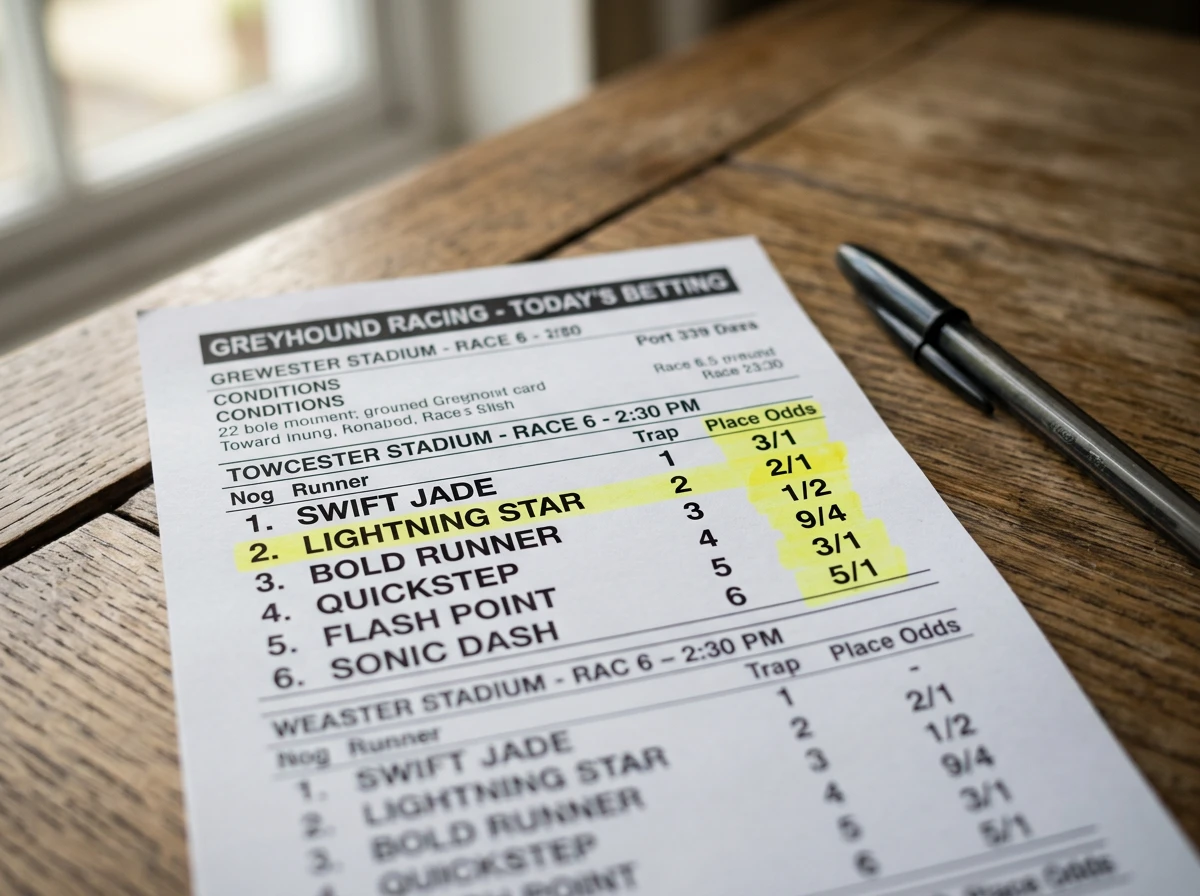
Why Each-Way Bets Suit 6-Runner Greyhound Fields
I placed my first each-way greyhound bet at Romford on a freezing Tuesday evening, mostly because I had no idea what I was doing and the bloke next to me said it was “the safe option.” He was wrong about it being safe, but he was onto something about greyhound fields being uniquely suited to each-way betting.
In horse racing, you might face a 16-runner handicap where place terms cover four spots. In greyhound racing, every race has six runners. That distinction matters more than most bettors realise. Standard each-way terms on a six-dog race pay out on the first and second finishers, at one-quarter of the win odds. With only six runners, a place finish covers a third of the field — a far more generous proportion than most horse racing scenarios.
Favourites win roughly 30-35% of graded greyhound races across the UK’s 18 licensed stadiums, but the rate at which they finish in the first two is considerably higher. That gap between winning and placing is exactly where each-way betting finds its purpose. You are not betting on certainty; you are buying coverage against the narrow margins that decide greyhound races — a bump at the first bend, a slow break from the traps, a rail runner getting crowded.
Each-way is not a crutch for indecisive punters. Used properly, it is a structured way to manage the variance that six-dog fields naturally produce. Used carelessly, it doubles your stake on selections that offer no mathematical advantage in either the win or place component. Understanding the mechanics separates those two outcomes.
See also: how to win greyhound betting — your complete greyhound betting portal.
How Each-Way Payouts Are Calculated in Greyhound Racing
The first time I sat down and actually calculated an each-way return — pen, paper, no app — I realised I had been throwing money at these bets for months without understanding what I was buying. So let me walk through this properly, because the arithmetic is not complicated but it is frequently misunderstood.
An each-way bet is two separate bets of equal stake: one on your selection to win, and one on your selection to place. In greyhound racing, “place” means finishing first or second. The place part pays at a fraction of the win odds — standard terms are one-quarter of the win odds.
Suppose you back a greyhound at 8/1 each-way with a 5 pound unit stake. Your total outlay is 10 pounds (5 on the win, 5 on the place). If the dog wins, you collect the win return of 5 x 8/1 = 40 pounds profit, plus the place return of 5 x 2/1 (one-quarter of 8/1) = 10 pounds profit, totalling 50 pounds profit on a 10-pound outlay. If the dog finishes second, you lose the 5-pound win stake but collect the place return of 10 pounds profit, giving you a net profit of 5 pounds. If it finishes third or worse, you lose both stakes — 10 pounds gone.
The bookmaker’s overround — that built-in margin of roughly 25% on a typical six-dog race — applies to both components of your each-way bet. The place odds are derived from the win odds, which already include the overround. You are not escaping the margin; you are splitting your exposure across two outcomes within the same margin structure.
Where each-way gets interesting is with the implied probability. At 8/1, the implied win probability is about 11.1%. But the implied place probability (finishing in the top two of six runners) is considerably higher. If you believe the dog’s true chance of placing is better than the implied odds suggest, the place component carries positive expected value even when the win component does not. That asymmetry is what makes each-way betting tactically useful rather than just a hedge.
One detail that trips up newcomers: each-way terms can vary. Most bookmakers offer 1/4 odds for places on greyhound racing, but it is worth confirming before you bet. Some tote pools have different place structures altogether.
When Each-Way Offers Better Expected Value Than a Win Bet
A dog priced at 2/1 each-way is a terrible each-way proposition. I know this because I have the spreadsheets to prove it from my first year of tracking. At 2/1, the place part pays 1/2 (one-quarter of 2/1), meaning your 5-pound place stake returns just 2.50 profit on a place finish. You have staked 10 pounds total. A second-place finish nets you a loss of 2.50. The place component barely justifies its own existence at those odds.
Each-way betting gains its edge at longer prices — typically 5/1 and above. At these odds, the place component becomes a meaningful return. A 10/1 shot finishing second pays 5/2 on the place, turning a total loss into a respectable profit. The mathematics tilt further in your favour as the price lengthens, provided you are not simply backing long shots for the sake of it.
The scenarios where each-way consistently outperforms a straight win bet share common characteristics. The dog has genuine early pace but draws an awkward outside trap, reducing its win probability while barely affecting its top-two chance. Or the race features one dominant short-priced favourite alongside five similarly matched runners — your selection’s placing probability is far higher than its winning probability because the favourite is likely taking one of the top-two spots regardless.
I have also found each-way value in races where a class dropper is returning from a break. The form suggests the dog is better than its current grade but there is enough uncertainty about fitness to push the win odds out. The form analysis might tell you this dog places comfortably; the market prices it as a risky win bet. That gap is where each-way earns its keep.
A useful mental test: before placing an each-way bet, ask yourself whether you would back the dog for place only at the offered place odds. If the answer is no, the each-way is not adding value — you are just diluting a win bet with a weak hedge.
Pitfalls of Each-Way Betting on Short-Priced Favourites
Every Saturday evening meeting produces the same scene: a dog opens at even money, drifts to 6/4, and half the crowd backs it each-way “just in case.” I have watched this play out hundreds of times, and the maths never improves.
At evens (1/1), the place component pays 1/4 — that is 25p return for every pound staked on the place. A second-place finish means you lose 75p of your place stake and the entire win stake. You have doubled your total outlay for trivial insurance. At 6/4, the place component pays 3/8, barely better. The pattern holds for anything under 3/1: the place return is too small to offset the doubled stake in any scenario except a win, and if you are confident it will win, you should be backing it win-only at full stake.
The other trap I fell into early on was treating each-way as a default bet type rather than a selective tool. Betting each-way on every selection in a card is a reliable way to inflate your outlay without improving your expected return. Over a 12-race card, you have effectively bet 24 times instead of 12, and the additional 12 bets are all at reduced odds.
Learn about forecast betting in greyhound racing.
There is also a behavioural pitfall worth naming. Each-way betting feels like a partial win when the dog places, and that feeling can mask a losing strategy. A bettor who backs five 3/1 shots each-way and gets two placed finishes and no winners has lost money — but it does not feel like five losses. The emotional framing is more forgiving than the P&L statement. This is exactly why disciplined record-keeping matters: the numbers strip away the comforting narrative and show you what each-way betting is actually doing to your bankroll.
None of this means each-way betting is inherently poor. It means it is a precision tool that gets misused as a comfort blanket. At the right price, on the right selection, in the right race shape, each-way is one of the smarter structural bets available in greyhound racing. Everywhere else, it is just a more expensive way to lose.
