
Greyhound Grade Drop Strategy: Betting When a Dog Drops in Class
 Available in US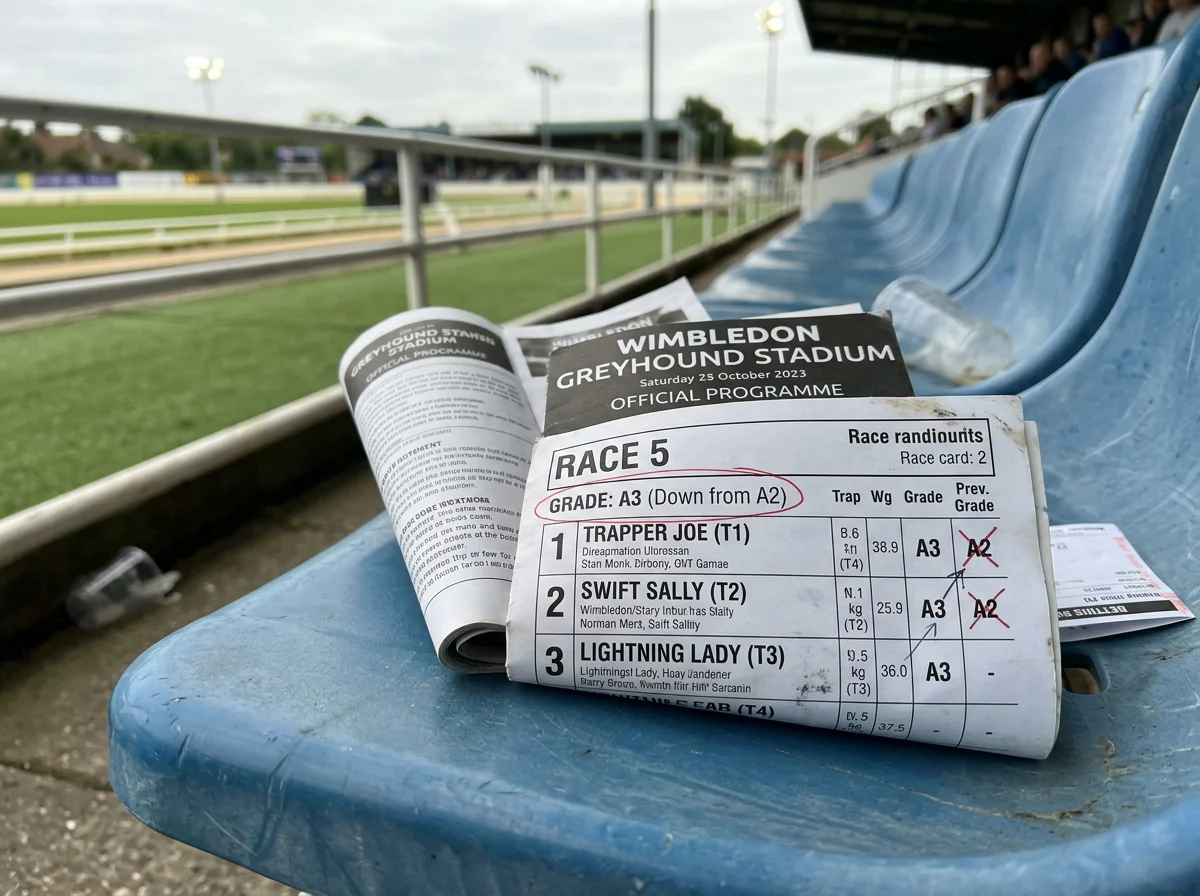
Why Grade Drops Create Opportunity in Greyhound Betting
One of my most profitable months in greyhound betting came from a single, repeatable pattern: backing dogs that had just dropped a grade after finishing mid-pack in stronger company. The principle is simple. A dog racing in A2 against faster rivals and finishing fourth is not the same proposition as a dog that has been plodding around in A4 and never threatened. When that A2 dog drops to A3, it enters a field of slower opponents — and the market does not always adjust its price quickly enough to reflect the class advantage.
The UK grading system assigns greyhound races into categories based on the ability of the runners, with A1 representing the highest standard of graded racing and lower numbers indicating less competitive fields. Across the 18 GBGB-licensed stadiums, approximately 25,000 BAGS races are run annually, the majority of which are graded. Each dog’s grade is determined by its recent results: consistent poor finishes lead to a drop, consistent strong finishes lead to a rise.
Grade drops matter to bettors because they represent a structural change in the competitive landscape around a dog. The dog’s ability has not changed overnight; its opposition has. A greyhound that ran 29.50 in an A2 race and finished fourth will often run a similar time in A3 — but 29.50 in A3 might be good enough to win. The form figures show a string of 4th and 5th place finishes, which discourages casual bettors and pushes the odds out. That is where value lives.
See also: how to win greyhound betting — complete greyhound betting coverage.
How the UK Greyhound Grading System Assigns Race Classes
I had been betting on greyhounds for six months before I properly understood how the grading system worked. The race card shows a grade letter and number, but the mechanics behind those designations are more nuanced than they appear.
Each GBGB-licensed track operates its own grading system within a broadly standardised framework. Dogs are graded primarily on finishing times at that track, adjusted for distance. A dog consistently running fast times moves up; a dog running slower times or finishing out of contention moves down. The grading process typically reviews a dog’s most recent six to eight runs, with more weight given to the latest performances.
The key distinction is between graded races and open races. Graded races restrict entry by class, so an A3 race features only dogs currently rated at A3 level. Open races — including the sport’s biggest events — have no grade restrictions and attract the best dogs regardless of classification. In open races at major venues like Nottingham or Towcester, favourites can win up to 52% of the time because the quality separation between contenders is clearer. In graded races across all tracks, the average favourite win rate sits closer to 33%.
Understanding the grading system is not optional for serious greyhound bettors. It is the framework that determines the competitive context of every race, and without that context, form figures are just numbers without meaning.
Reading Grade Movements: When a Drop Signals Value
Not every grade drop is a buying signal. I have learned this through enough losing bets on downgraded dogs to know that the reason for the drop matters as much as the drop itself.
The drops that produce value share a recognisable profile. The dog’s finishing times have been competitive for its previous grade, but positional finishes have been poor — fourth or fifth in races where the first three pulled away on early pace or benefited from favourable trap draws. When you look at the sectional times rather than just the finishing positions, the dog was not slow; it was beaten by circumstance more than ability. The grade drop moves it into a field where its times are at or near the top, and the form figures do not reflect this because form figures record position, not pace.
Another strong grade-drop signal is the trap draw improving with the class change. A dog that has been racing from trap 5 or 6 in A2 and getting crowded at the first bend might find itself drawn in trap 1 or 2 in its first A3 start. The combination of weaker opposition and a better starting position compounds the advantage — the kind of double edge that casual bettors, focused on a string of “4-5-4-3” position finishes, routinely overlook.
The market’s response to grade drops is inconsistent, which is what makes them exploitable. Sometimes a class dropper is correctly identified as the standout runner and opens at short odds with no value. Other times, especially in afternoon BAGS meetings with less market attention, the class dropper drifts to prices that significantly overstate its chance of losing. Comparing the dog’s recent times against the typical winning times for the lower grade at that track is the quickest way to assess whether the drop has created genuine value or just moved a declining dog to a more suitable level.
When a Grade Drop Is Misleading: Injury, Age and Fitness Flags
I backed a dog at Sunderland last year that had dropped from A1 to A3 in the space of a month. On paper, it looked like a class act falling into a weak field. In reality, the dog had picked up a minor muscle injury, missed two weeks, returned unfit, and was running on diminished ability. The grade drop was not a competitive adjustment — it was a decline tracker. The dog finished fifth.
The most common false signal in grade-drop betting is the aging greyhound. Greyhounds peak between roughly two and four years of age. A dog dropping grades at age five is almost certainly declining in raw ability, not being unfairly assessed by the grading system. Its times are getting slower because it is getting slower, and the grade drop simply reflects this reality. Backing these dogs as though they retain their former class is a reliable way to lose money.
Explore running style analysis for greyhound betting.
Injury returns are another red flag. A dog that has missed three or more weeks and returns at a lower grade may not have fully recovered. The first run back is often a fitness test — the trainer is gauging whether the dog is ready to compete, not aiming for a win. Identifying these trial runs requires checking the gap between the dog’s last race date and the current one, and noting whether the trainer has a pattern of using lower grades as comeback runs.
Weight changes can also signal fitness issues. A dog that has gained significant weight between runs may be carrying excess condition that slows its early pace. A dog that has lost weight may have been through a health issue. Neither pattern is absolute, but a weight change of a kilogram or more between consecutive races, combined with a grade drop, should prompt closer examination before you treat the class advantage as automatic.
The practical filter I apply is straightforward: I only treat a grade drop as a value signal when the dog’s recent sectional times remain competitive for its previous grade, the gap between races is less than two weeks, and there is no significant weight change. If any of those conditions fails, I move on. Grade drops offer some of the best structural edges in greyhound betting, but only when the drop reflects a grading quirk rather than a genuine deterioration in the dog’s racing ability.
