
Greyhound Lay Betting Strategy: Opposing Runners on the Exchange
 Available in US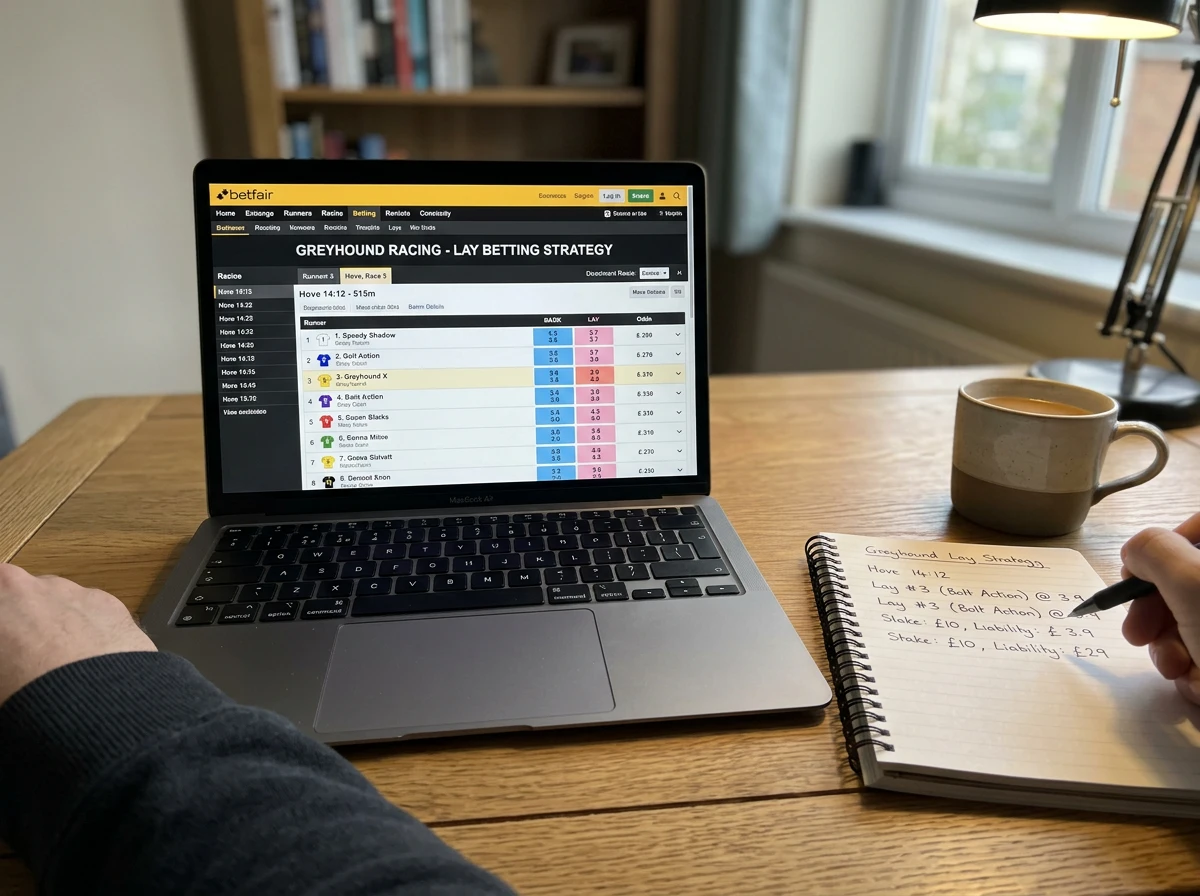
How Lay Betting Reverses the Punter-Bookmaker Relationship
Most greyhound bettors spend years backing dogs to win before discovering they can do the opposite. Lay betting flips the entire dynamic — instead of predicting which dog will win, you are predicting which dog will lose. And given that favourites win only about 30-35% of graded races, the mathematical starting point for laying is that any individual dog loses roughly two-thirds of the time or more.
On a betting exchange, every bet has two sides. When you back a dog, someone else is laying it. When you lay a dog, you are taking the role of the bookmaker — accepting someone else’s bet and paying out if the dog wins. The crucial difference from traditional bookmaking is that you set (or accept) a specific price and you are exposed to a single runner, not the entire field.
This reversal changes what “good analysis” means. A traditional backer looks for dogs whose true winning chance exceeds the implied probability in the odds. A layer looks for the opposite: dogs whose odds are shorter than their true winning chance warrants. The dog priced at 2/1 that you believe has only a 25% chance of winning, not the 33% implied by the price, is a lay candidate. You are not betting against the dog in an emotional sense — you are betting that the market has overestimated its probability.
See also: how to win greyhound betting — your greyhound betting hub.
Lay Bet Mechanics: Liability, Matched Amounts and Profit
I remember the first time I placed a lay bet on a greyhound exchange. I typed in 10 pounds at 3.0 (decimal odds), hit confirm, and then stared at the “liability” figure — 20 pounds — with genuine confusion. Understanding liability is the single most important mechanical concept in lay betting, and getting it wrong is expensive.
When you lay a dog at decimal odds of 3.0 for a 10-pound backer’s stake, your profit if the dog loses is 10 pounds (the backer’s stake, minus exchange commission). But your liability if the dog wins is 20 pounds — because you owe the backer their 10-pound stake multiplied by (odds minus 1). At odds of 3.0, that is 10 x 2.0 = 20 pounds. The higher the lay odds, the greater your liability per pound of potential profit.
This is where the overround dynamic becomes relevant. A typical six-dog greyhound race carries a bookmaker overround of roughly 125%, meaning the sum of implied probabilities exceeds 100% by about 25 percentage points. On the exchange, the overround is typically much lower — often 103-108% — because there is no bookmaker margin, only the commission charged by the exchange (usually 2-5% of net winnings). That tighter market means exchange odds more accurately reflect the collective assessment of each dog’s chances. For a layer, this is a double-edged reality: the odds are fairer, so finding genuine overlays to lay requires sharper analysis.
The profit and loss arithmetic is simple once you internalise it. Lay at 2.5 for 10 pounds: you risk 15 to win 10 (minus commission). Lay at 5.0 for 10 pounds: you risk 40 to win 10 (minus commission). The risk-reward ratio deteriorates rapidly at longer odds, which is why most profitable lay strategies focus on runners priced between 2.0 and 4.0 on the exchange.
Identifying Greyhounds Worth Laying
Laying a dog simply because it is the favourite is not a strategy — it is a coin flip with bad liability. Second favourites win 16-18% of greyhound races, but short-priced favourites win at higher rates in specific conditions. The edge in lay betting comes from identifying when a particular dog’s odds are shorter than its form and circumstances justify.
The scenarios that produce lay opportunities tend to share certain characteristics. A dog with a strong recent run at a different track is drawn in an unfavourable trap at today’s venue. The market focuses on the most recent result — a flashy win — while underweighting the trap draw. Or a dog that has been dropping in grade is backed as though the class drop guarantees improvement, when the reason for the drop is declining ability rather than bad luck at a higher grade.
Richard Wayman of the British Horseracing Authority noted that fewer larger-staking customers have shifted market dynamics due to affordability checks. That same dynamic applies to greyhound exchanges: thinner markets mean individual bets can move prices disproportionately, creating situations where a single confident backer pushes a dog’s odds shorter than the form warrants. These artificial shortenings are opportunities for the disciplined layer.
I look for three specific signals before laying a greyhound. First, a mismatch between trap draw and running style — a wide runner drawn in trap 1, for instance, is likely to encounter traffic at the first bend regardless of ability. Second, a pattern of inconsistent sectional times suggesting the dog’s recent form is unreliable. Third, a significant odds shortening in the final minutes before the race that is not supported by corresponding moves from other sharp market participants. If the dog is drifting on the exchange while shortening with a single bookmaker, that tells me the exchange — where informed money tends to sit — does not share the bookmaker’s assessment.
Managing Liability: The Risk That Catches New Lay Bettors
The fastest way to blow up a lay betting bankroll is to lay a 10/1 shot because “it has no chance.” I did exactly this in my second month of exchange betting and watched a 100-pound liability wipe out three weeks of careful 10-pound profits. The lesson cost me money, but it was cheap compared to what it taught me about exposure management.
Liability management starts with a fixed maximum exposure per race. I cap my lay liability at 5% of my exchange bankroll, regardless of how confident I am in the selection. A lay at 3.0 for a 20-pound backer’s stake means 40 pounds liability — if that exceeds 5% of my bankroll, I reduce the stake until it fits. This hard limit prevents a single losing lay from meaningfully damaging the fund.
Compare exchange vs bookmaker betting for greyhounds.
The second discipline is never laying at odds above 5.0 for standard selections. At those odds, you are risking four times your potential profit, and the implied probability of the dog winning (20%) is still significant. A dog priced at 8.0 on the exchange has a 12.5% implied chance of winning — roughly one in eight. Over a sustained period, that one-in-eight will arrive, and when it does, the liability will erase multiple successful lays.
Staking consistency matters here more than in traditional backing. A backer who wins at 10/1 can afford several losers. A layer who loses at 10/1 needs ten successful lays at the same liability just to break even. The asymmetry punishes inconsistency and rewards rigid stake discipline. Flat liability staking — where you set the same maximum liability for every lay rather than the same backer’s stake — is the approach I use and the one I recommend. It keeps your worst-case outcome constant regardless of the odds.
One final point that experienced layers learn the hard way: exchange liquidity on greyhound markets is often thin, particularly on afternoon BAGS meetings. A lay bet placed at 3.0 may not get matched at that price, and if you adjust upward to get matched, you are accepting worse odds and higher liability. Always check the available liquidity before committing to a lay strategy on a specific race. If the market is too thin to get matched at your target price, the correct action is to skip the race, not to chase the match at unfavourable odds.
