
Smart Money in Greyhound Betting: Reading Market Moves Before the Off
 Available in US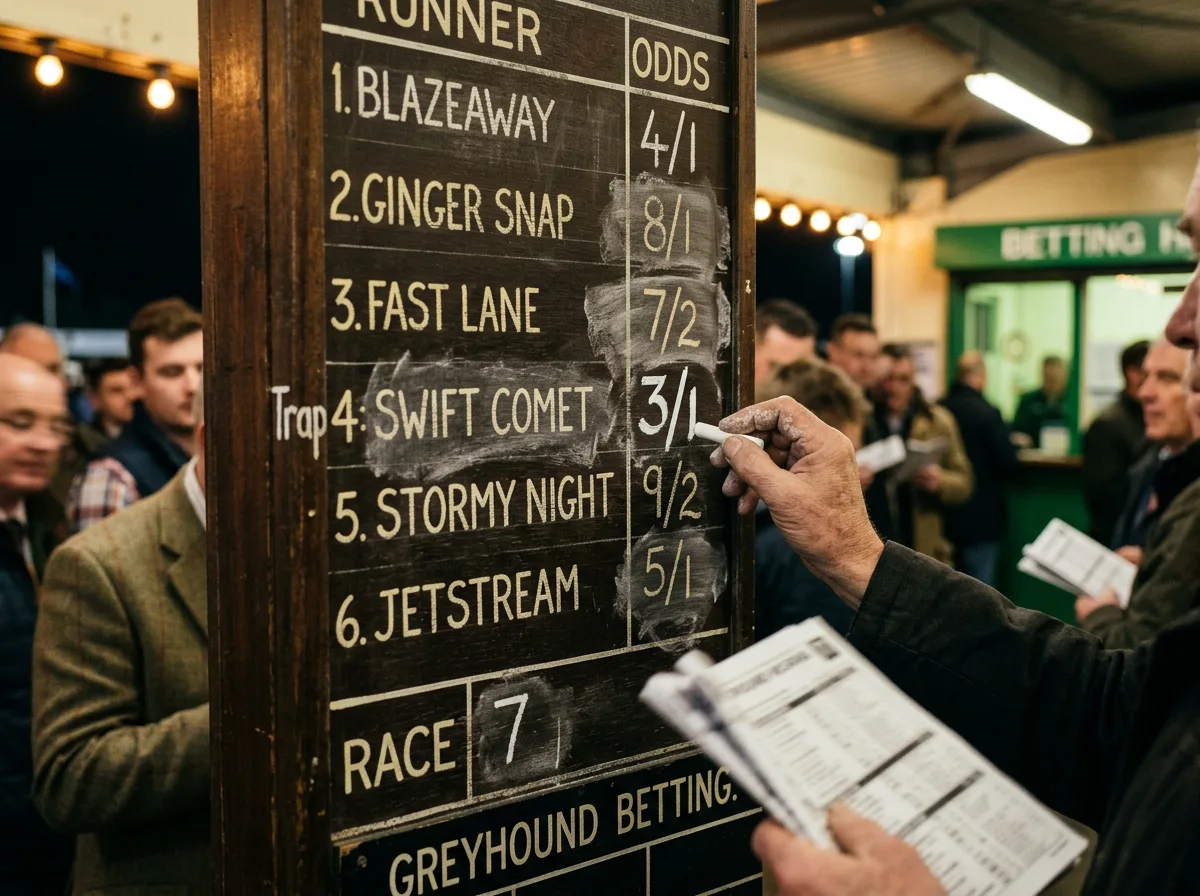
What Odds Movements Tell You About Informed Greyhound Money
At 19:28, four minutes before the off at Romford, a dog that had been drifting all afternoon from 5/2 to 7/2 suddenly shortened to 2/1 across three bookmakers simultaneously. I had already done my form work and rated this dog as the likely winner based on sectional times and a favourable trap switch. The late money confirmed what my analysis suggested — and the dog won by three lengths.
Odds movements in greyhound markets are not random noise. They reflect the flow of money into the market, and when significant sums arrive on a single runner shortly before a race, they often represent informed opinion — people with knowledge of the dog’s current condition, trial form, or preparation that the broader market has not yet priced in. UK greyhound betting turnover reached approximately 1.5 billion pounds in 2022-23, and within that volume, the movements of sharp money leave detectable traces in the odds.
Reading these movements is not a standalone strategy. It is a confirmation tool — a way to validate or challenge your form-based assessment before committing your stake. Used in isolation, following market moves produces mediocre results because not every move represents genuine information. Used alongside rigorous analysis, it adds a dimension that pure form study cannot provide.
See also: how to win greyhound betting — your greyhound betting resource.
Spotting Steam Moves and Significant Drifts
A “steam move” is a sharp, sudden shortening of odds that occurs when a substantial volume of money lands on a runner in a compressed timeframe. In greyhound markets, steam moves are more visible than in horse racing because the total market liquidity is lower — a few hundred pounds of informed money can move the price by a full point or more.
The characteristics of a genuine steam move, as distinct from normal market fluctuation, are specific. The price shortens at multiple operators simultaneously, not just one. The move happens in the final 5-10 minutes before the race, when sharp bettors typically place their money to minimise the time the bookmaker has to react. The dog was not already favourite — steam moves on dogs priced 4/1 or longer are more likely to represent new information than further backing of an already-obvious favourite.
Drifts — where a dog’s odds lengthen — carry their own information. A greyhound that opens at 2/1 and drifts to 7/2 without any corresponding shortening of another runner in the field is being abandoned by informed money. Favourites win about 33% of graded races, but drifting favourites win at significantly lower rates because the market is actively reassessing their chances downward. When a favourite drifts, the race becomes more open, and mid-market selections gain value.
The practical tool for monitoring these movements is a price comparison service that shows live odds across multiple bookmakers. Watching a single operator’s prices tells you about that operator’s liability management; watching multiple operators simultaneously reveals genuine market-wide moves driven by information rather than individual bookmaker adjustments.
When Smart Money Enters Greyhound Markets
Mobile betting accounts for over 70% of all greyhound wagers, and the timing of that money flow follows predictable patterns that help distinguish informed from uninformed betting.
Early prices on greyhound races — published several hours before the off — attract two types of bettor: recreational punters who bet casually based on form figures, and sharp bettors who take early value before the market corrects. The early market is typically soft (wider overround, less efficient pricing) and can offer genuine value to bettors who have done their homework.
The bulk of market shaping happens in the final 15-30 minutes before the race. This is when the majority of money arrives, and it is when informed moves are most likely to occur. A dog that has been stable at 3/1 all afternoon and suddenly shortens to 2/1 in the last ten minutes is receiving attention from bettors who act late to minimise their exposure to bookmaker countermeasures. These late movers are often the most informed participants in the market.
Exchange markets offer a different timing window. The exchange typically builds liquidity later than bookmaker markets, with significant money arriving in the final 3-5 minutes. Exchange movements in this window are particularly informative because exchange bettors include professional punters and traders who are less likely to be acting on sentiment or superstition.
Following or Fading Market Movers: What the Data Suggests
The obvious question is: should you follow smart money or bet against it? The answer, frustratingly, is that it depends on the context, and blanket rules in either direction produce inconsistent results.
Following steam moves on greyhounds that are shortening from medium prices (4/1 to 6/1 range) into shorter prices tends to be profitable in my experience, particularly when the move aligns with positive form indicators. The combination of informed money and strong form creates a double signal that is correct often enough to overcome the bookmaker’s margin. Second favourites win 16-18% of the time at the aggregate level, but second favourites that have steamed from longer odds into the second-favourite position win at a higher rate, because the price movement reflects new information that the market is still absorbing.
Check the favourite win percentage stats in greyhound racing.
Fading steam moves — betting against heavily backed dogs — is riskier but can be profitable in specific circumstances. When a dog steams on the strength of a single impressive trial time that may not replicate under race conditions, or when the steam appears to originate from a single large bet rather than broad-based informed backing, opposing the move can offer value on the rest of the field. The key is distinguishing genuine informed money from a single punter’s confidence.
What I avoid entirely is following moves on dogs already at short prices. A favourite shortening from evens to 4/6 is receiving money that confirms the obvious, not money that reveals new information. At 4/6, the implied probability is 60%, and the dog needs to win six races in ten to break even. The market has already priced in the dog’s quality; the late money is just adding confirmation at an unplayable price.
The most practical approach I have developed is to complete my form analysis before checking the market. I identify my selection based on sectional times, trap draw, grade and trainer form. Then I check the market movements. If my selection is being backed by smart money, I increase my confidence in the bet. If it is drifting, I reassess whether my analysis has missed something. If a dog I have not selected is steaming, I investigate whether the move reveals information my form work did not capture. The market is a data point, not a dictator — and using it as one component of a structured approach produces better results than treating it as the entire strategy.
